

Ransomware took down check-in at 4 of Europe's busiest airports in a single weekend. Jet fuel prices have nearly doubled. And the U.K. is close to passing its biggest update to cyber regulation since 2018. Our buyer's guide to aviation resilience software breaks down the threats facing airports and airlines today, and the software capabilities that help operators stay ahead of them.
The size and weight of global aviation
If global aviation were a country, it would rank 20th in the world by GDP. The sector supports 86.5 million jobs and $4.1 trillion in economic activity, or 3.9% of global GDP, according to the Air Transport Action Group's Aviation: Benefits Beyond Borders report. Airlines alone expect to earn $839 billion in ticket revenue in 2026, according to IATA.
But the sector's value goes well beyond the numbers. Airports and airlines move tourists and business travelers, carry roughly a third of world trade by value, and deliver emergency medical supplies and personnel. When aviation is disrupted, the effects ripple across the global economy.
Major resilience threats to global aviation
Like every sector of its size and reach, aviation faces serious resilience challenges, and many have intensified over the past year. Here are the biggest threats airports and airlines face today:
Cyberattacks and data breaches
Cyber incidents are now the top risk on the aviation sector's agenda. In Allianz's 2025 Risk Barometer, cyber ranked 1st among aviation risks, ahead of business interruption and regulatory change.
The threat is growing quickly. An industry report based on market intelligence and incident analysis found:
- A 600% year-on-year increase in ransomware attacks on the aviation sector
- 27 major attacks by 22 ransomware groups between January 2024 and April 2025
- Credential theft or unauthorized access to critical systems in 71% of incidents
Attackers have since shown how far a single breach can reach. In September 2025, ransomware hit a widely used passenger processing platform, knocking out automated check-in and boarding across major European airports.
Nor is the damage limited to operations. In mid-2025, attackers used a social engineering call to access a third-party customer service platform at a major Asia-Pacific airline. And in early 2026, a U.S. airport disclosed a ransomware attack in which files were taken from its systems.
The common thread is that attackers increasingly come through suppliers, call centers, and shared platforms rather than an organization's own front door.
Third-party IT outages
Not every disruption is malicious. Like most major industries, aviation has embraced digital services to improve the passenger experience. Paradoxically, that has created heavy reliance on third-party IT vendors. These services usually work seamlessly. When they fail, the effects cascade.
In July 2024, a faulty software update from a single security vendor crashed millions of Windows machines worldwide. The world's 20 largest airlines cancelled 9,650 flights over the following 3days, according to OAG data. One U.S. carrier alone put its losses at more than $500 million and 1.3 million disrupted customers.
Fragile aviation supply chains
Airlines don't just depend on suppliers for software. They depend on them for aircraft and engines, too, and that supply chain is badly strained. The global order backlog reached 18,100 aircraft as of May 2026, up from 17,000 in 2024, and IATA estimates the industry has received at least 5,300 fewer aircraft than it needed, according to Airways Magazine and IATA's supply chain analysis. IATA doesn't expect the gap to close before 2031 to 2034.
The result is an aging fleet. The average aircraft is now a record 15.2 years old, and older aircraft cost more to maintain, burn more fuel, and are harder to keep in service, IATA's director general told its 2026 annual meeting.
Fuel efficiency gains, historically about 2% a year, slowed to just 0.3% in 2025. Leasing costs have climbed as airlines compete for scarce aircraft.
For operators, that means more unplanned maintenance, more spare-parts delays, and less slack in the schedule when something goes wrong.
Labor shortages
Demand for air travel is outpacing the industry's ability to train and keep skilled people. Boeing's 2026 Pilot and Technician Outlook projects that commercial aviation will need more than 2.4 million new personnel over the next 20 years, including 674,000 pilots, 728,000 maintenance technicians, and 1,023,000 cabin crew.
Maintenance is under particular strain. Without intervention, the global shortage of aviation maintenance technicians could reach 60,000 by 2029, according to McKinsey. The pandemic accelerated retirements, the field struggles to attract younger workers, and those who are interested often can't find enough training capacity.
Severe weather, fire, and power failures
Severe weather is a perennial challenge, and its effects can be enormous. In January 2026, a winter storm across the U.S. led airlines to cancel more than 11,400 flights in a single day, the highest daily total since 2020. Weather can also damage critical infrastructure directly. In June 2026, an airport in the U.K. closed to all flights after a thunderstorm caused a fault in its air traffic control systems.
Fire and power failures pose a similar threat. In March 2025, a fire at an electrical substation several miles from a major European hub cut power to the airport and shut it down for about 18 hours.
These events are a reminder that an airport's resilience depends on infrastructure it doesn't own, and on how fast it can make decisions when that infrastructure fails.
Regulatory pressure
Aviation is treated as critical infrastructure in most jurisdictions, and regulators are raising expectations for security and resilience in response to the global threats picture.
In the U.K., the Cyber Security and Resilience (Network and Information Systems) Bill is in its final parliamentary stages. Introduced in November 2025, it updates the NIS Regulations 2018, expands the range of organizations in scope, and brings the U.K. closer to the EU's NIS2 Directive. It also gives regulators new powers to designate critical suppliers, which matters for a sector that relies so heavily on third parties. Royal Assent is expected between late 2026 and spring 2027, with most detailed duties to follow in secondary legislation.
In the EU, NIS2 already classes air transport as a sector of high criticality. Covered airports, airlines, and air traffic operators must take appropriate and proportionate technical, operational, and organizational measures to manage risks to their network and information systems.
Those measures must follow an all-hazards approach. In practice, that means protecting both systems and the physical environment that houses them from any event that could compromise them, including:
- Sabotage, theft, and unauthorized physical access
- Fire, flood, and natural phenomena
- Telecommunications and power failures
- System failures and human error
For resilience teams, the takeaway is that cyber security, physical security, and business continuity can no longer be managed in separate silos. Regulators expect them to work as one program, with evidence to prove it.
Aviation resilience software capabilities for airports and airlines
Faced with this mix of threats, many airports and airlines are moving away from spreadsheets, paper plans, and disconnected point tools toward integrated, aviation resilience software. The right platform manages every incident, investigation, and corrective action, from a minor customer complaint to a major emergency, in one place. It also brings safety, security, operations, business continuity, and critical event management onto a single shared picture.
These are the capabilities that matter most:
Coverage of all airport operations
Running an airport involves constant coordination across the terminal, airside, and landside. The best aviation resilience software supports all 3.
- Terminal operations: Concessionaires, inter-terminal transport delays, gate and flight information, customer complaints, lost property, baggage system bottlenecks, and baggage turnaround audits.
- Airside operations: Regulatory inspections, runway and taxiway conditions, foreign object debris (FOD), wildlife strikes and wildlife management, aircraft movements, weather conditions and forecasts, de-icing, pushbacks, airside vehicle control, and time-critical hazard information.
- Landside operations: An area many tools overlook, including parking and garage status, carpark inspections, commercial leases and maintenance, and transport capacity for buses, trains, taxis, shuttles, and rideshare services.
Safety and security
Keeping passengers and staff safe is a core duty for every aviation organization. Look for functionality that handles airport and airline emergency events, case management, airside security events, scheduled and special-condition inspections, and airworthiness and flight operations. It should also support aviation security operations and every element of the safety management system (SMS).
Business continuity
Too many aviation organizations still run continuity programs on manual, paper-based processes, which leaves them reacting to disruption instead of preparing for it. Business continuity software brings business impact analyses, dependency mapping, exercises, and recovery strategies into a single workspace.
Dependency mapping deserves special attention. As the outages above show, knowing which suppliers, systems, and sites each critical service relies on is what lets you respond quickly when one of them fails. Workflow automation then streamlines approvals and triggers real-time notifications and recovery steps, so response doesn't stall waiting for the right person.
Critical event management
Emergency management also remains largely manual across the industry. Airports need digital tools to activate their Emergency Operations Center (EOC) quickly and manage aircraft emergencies, major facility disruptions, and security threats.
With the right platform, each event is assessed for impact throughout its lifecycle, and the EOC can scale up or down to match. Crisis and emergency teams follow the same plans, share the same information, and use digital playbooks and checklists to automate responses and track critical tasks. When a check-in system goes down or a power supply fails, that shared picture is the difference between hours of confusion and a coordinated response.
Critical infrastructure and threat intelligence
Beyond meeting their obligations as critical infrastructure operators, airports and airlines have every reason to anticipate threats earlier and respond faster.
Aviation resilience software helps organizations consolidate information about critical assets, including descriptions, locations, and key functions. It can also notify the right people automatically when that information changes, so regulators get timely updates. Threat intelligence features pull feeds from multiple sources into situational awareness dashboards with real-time alerts. And incident management tools speed up response with automated email, SMS, and voice notifications.
Questions to ask aviation resilience software vendors
Capabilities on our feature list are only part of the picture. Before you choose a platform, ask each vendor:
- Does it work when other systems don't? If your network, email, or check-in platform goes down, can responders still reach the plans, contact lists, and checklists they need?
- Can it map dependencies on third parties? Can you see which critical services rely on which vendors and systems, and model what happens when one fails?
- Is it truly one platform? Do safety, security, operations, continuity, and emergency management share the same data, or are they separate modules stitched together?
- Can your team configure it? Can you adapt workflows, forms, and playbooks to your procedures without custom development every time something changes?
- Will it produce regulator-ready evidence? Can it generate audit trails and reports that show how you meet NIS2, the UK's updated NIS regime, and your national aviation security requirements?
- Does it integrate with what you already use? Look for connections to flight information systems, building management, mass notification, and threat intelligence feeds.
- How is it secured and hosted? Ask about certifications, data residency, and how the vendor manages its own supply chain risk.
Driving proactive resilience for airports and airlines
Aviation is central to the global economy, and it faces resilience risks to match its size. Ransomware, vendor outages, fuel shocks, aging fleets, staff shortages, extreme weather, and rising regulatory expectations are all hitting at once.
Airports and airlines don't have to meet these threats with manual, paper-based processes or legacy software that can't keep up. Aviation resilience platforms like Noggin give them a comprehensive, holistic approach to resilience. They support collaboration and coordination, unlock critical insights, keep stakeholders informed, and streamline the workflows behind planning and response.
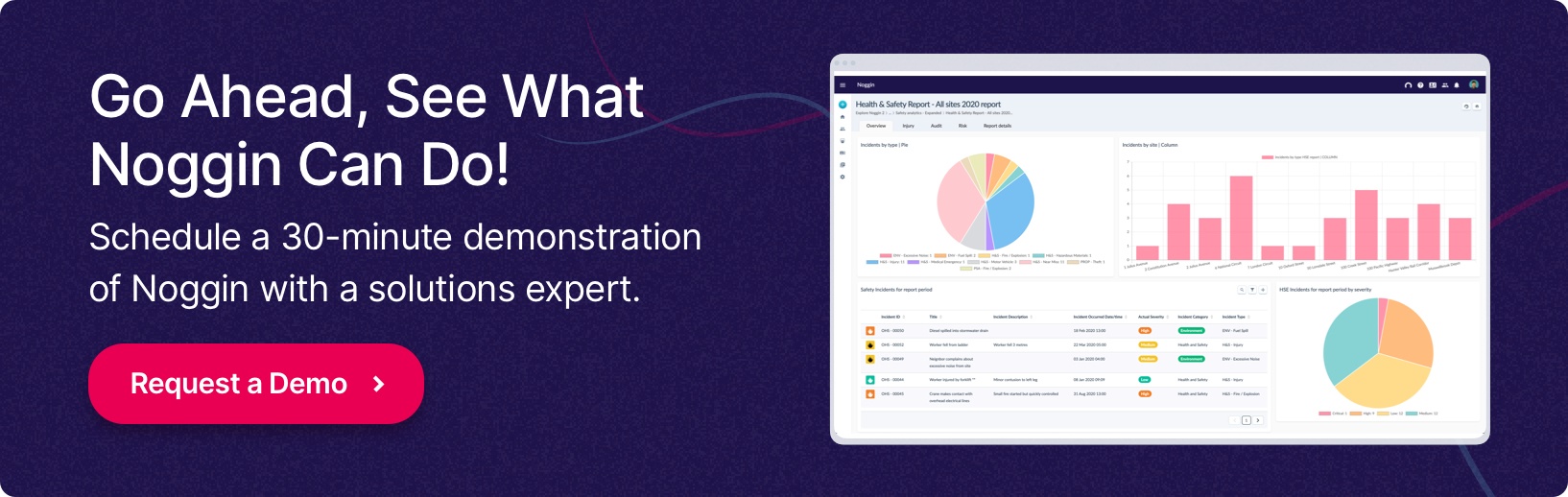
Don't just take our word for it, though. Request a demo to see Noggin in action.