

Navigating major crises, workforce safety and supply chain continuity requires a platform built for the complexities of modern production. This guide breaks down the core threats facing today’s manufacturing facilities, from critical event threats to workplace safety hazards, and outlines the essential software capabilities required to build a resilient, compliant enterprise.
The very large manufacturing sector
For many of the world’s largest economies, manufacturing is a critical enabler of economic growth and innovation. It’s also a massive employer.
In the U.S., the world’s second largest manufacturer after China, the manufactured goods value chain plus manufacturing for other industries’ supply chains accounts for about one third of GDP (Gross Domestic Product) and employment, according to the Manufacturers Alliance for Productivity and Innovation.
In 2023 alone, manufacturing contributed $2.3 trillion to national GDP, according to the Bureau of Economic Analysis. The Current Population Survey estimated that the sector employed some 15.6 million workers in that year, too.
Resilience risks to the manufacturing industry
These figures are evidence of the fact that manufacturing output affects every walk of life –the sector being so broad that it encompasses consumer goods, electronics, automotives, energy, and even healthcare.
Given this diversity of outputs, however, manufacturing is uniquely exposed to risks, many of which have intensified in recent years.
The top threats to resilience in the manufacturing sector include:
Work health and safety
The processes that go into producing manufactured goods lead to higher risk for nonfatal injuries than in many other sectors. In the U.S., injuries and illness among manufacturing workers represented 355,800 cases in 2023, according to data from the Department of Labor’s Bureau of Labor Statistics (BLS).
That same year, total injuries, although declining 6% from the previous year, still came in at 326,400, according to the agency’s estimates from the Survey of Occupational Injuries and Illnesses.
To put these numbers into perspective: for every 10,000 full-time manufacturing workers, there were 2.6 work injury cases and 2.7 illnesses. Point nine cases included days away from work.
What contributes to the safety risk profile in manufacturing, though? Workers in the industry tend to be injured due to the following factors:
-
Body stress
-
Falls, slips, and trips
-
Manual handling
-
Musculoskeletal disorders
-
Working with dangerous machinery and equipment
Other common hazards include:
- Body strain from repetitive movements, or from lifting, pushing, or pulling heavy loads
- Noise from machinery
- Crush injuries and fractures from workers getting hands or limbs caught in unguarded moving parts
- Burns
Fire and explosion
Fires and explosions are also recognized hazards in the industry, each contributing both injury and property damage. Causes of fires and explosions in manufacturing facilities include:
- Electrical hazards: Caused by overloaded circuits, faulty wiring, and/or the use of substandard electrical equipment.
- Machinery and equipment: Bearings that overheat, belts that create friction, and mechanical failures can generate enough heat to ignite nearby combustible materials.
- Hot work: Referring to any activity that generates sparks and open flames, such as welding, cutting soldering, and/or brazing.
- Combustible dust: Certain industrial processes generate dust that’s highly combustible. That dust can accumulate on surfaces and inside machinery. When airborne, the dust can create an explosive atmosphere.
- Flammable liquids and gases: Liquids and gases are staples in many industrial processes but may come with high fire and explosion risk.
Physical security and workplace violence
Although not as high as in healthcare, manufacturing has a relatively high incidence of workplace violence. Factors contributing to increased levels of violence in the workplace, such as high-stress environments with tight deadlines, long shifts, and interpersonal tensions, are present in most manufacturing settings.
Of course, workplace violence isn’t the only physical security threat the industry faces. Manufacturing facilities house valuable materials and expensive equipment. Add in high foot traffic, and it’s no surprise that theft, break-ins, and property damage are common in the industry.
Cargo theft incidents, for instance, rose nearly 60% from 2022 to 2023 in Canada and the U.S., according to data from CargoNet. Meanwhile, 2025 began with a string of high-profile attacks on automobile production lines.
Cybersecurity
Like most others, the manufacturing industry has embraced innovations, such as digital twins, robotics, AI, cloud computing, and the industrial internet of things (IIoT). These advances have driven growth and efficiency. But as analysts at the World Economic Forum (WEF) have highlighted, they’ve also exposed the industry to unprecedented cyber risk.
What are the numbers? IBM’s X-Force Threat Intelligence Report ranked manufacturing as the most targeted sector for cyberattacks for three years running, accounting for a quarter of attacks. Of these attacks, a staggering 71% involved ransomware – unsurprising given the industry’s famous intolerance for downtime.
The costs of individual attacks have gone up accordingly, increasing by 125% each year over the last three to $4.73 million, according to the WEF.
Severe weather
Another resilience threat to the industry is severe weather. In the U.S., severe weather events are becoming more prolific and more expensive to handle.
Just in 2024, the U.S. suffered 27 confirmed weather/climate disaster events with losses exceeding $1 billion, according to data from the National Centers for Environmental Information (NCEI). Particularly relevant to the industry, these disasters included one flooding event, 17 severe storm events, five tropical cyclone events, one wildfire event, and two winter storm events.
They also represent a trend. Where the 1980–2024 annual average was nine events exceeding $1 billion, the annual average for the most recent five years (2020–2024) has skyrocketed to 23.
Nor can U.S. manufacturers with global supply chains breathe easy, either. Extreme weather events have increased in kind and cost around the world, with studies showing increases in heat waves, heavy downpours, and tropical cyclones – all of which can and have affect(ed) manufacturing facilities.
Supply-chain risk
Severe-weather isn’t the only supply-chain risk manufacturers face. The race for rare-earth minerals, key components of many industrialized goods, particularly semiconductors, has been in the news of late. But as analysts at KPMG note, many resource-rich nations have taken the opportunity to “leverage their position in critical minerals,” often leaving manufacturers in dependent countries at a further disadvantage.
Besides critical minerals, supply-chain dependencies have increased in the industry more broadly. In its analysis of critical manufacturing supply-chain dependencies, the Cybersecurity and Infrastructure Security Agency (CISA) lists the following:
- Transportation Systems: Critical Manufacturing Sector depends on the Transportation Systems Sector to ship goods and materials. The Critical Manufacturing Sector also produces the ships, aircraft, trucks, that move those goods and materials.
- Energy: Critical Manufacturing Sector relies on energy to keep facilities running, but also produce turbines, switchgear, transformers, electric motors, etc.
- Chemical: Critical Manufacturing Sector depends on chemicals to process unrefined ore and treat processed metals and metal products, while also producing air and gas compressors, and nonagricultural spraying and dusting equipment, etc.
- Water: Critical Manufacturing Sector relies on water for its factories and facilities and, also, manufacturers iron pipes, valves, compressors, etc., for moving water.
Compliance
In the U.S., manufacturing is considered a critical infrastructure sector. That means manufacturing assets, systems, and networks, whether physical or virtual, are considered so vital to the country that their incapacitation or destruction would have a debilitating effect on security, national economic security, national public health or safety, or any combination thereof.
As a result, lawmakers and regulators have crafted any number of policies to strengthen and maintain secure, functioning, and resilient critical infrastructure. A recent law, the Cyber Incident Reporting for Critical Infrastructure Act of 2022 (CIRCIA), puts manufacturers on the hook for mandatory reporting should a critical incident take place.
CIRCIA mandates that the Cybersecurity and Infrastructure Security Agency (CISA) develop and implement regulations requiring covered entities, including critical manufacturers, to report covered cyber incidents and ransom payments.
Key manufacturing resilience software capabilities
To address this threat environment, manufacturers will need integrated software solutions to help them strengthen resilience through continuous improvement. Integrated resilience management software offers the necessary tools to build resilience for any type of manufacturer.
What software capabilities help manufacturers take their organizational resilience efforts to the next level? To help buying teams develop a solid list of business and software requirements before going to the market, we lay the capabilities out in the following buyer’s guide:
Flexible and easy to use
Industry threats aren’t just serious; they’re also changing every day. Software must adapt to this resilience environment. Otherwise, resilience personnel will find workarounds, and users will only grudgingly use the solution – if at all.
Seek out a flexible, drag-and-drop platform. These platforms enable no-code customization, which allows manufacturers to easily customize their solution to truly reflect their organization’s unique needs and preferences.
The pace of threats is also increasing, requiring resilience personnel to react more quickly than ever. Workflow automation capabilities help streamline and simplify an organization’s resilience processes, helping teams respond more efficiently to disruption.
Work health and safety
Safety management is a perennial challenge for the industry. And teams often decry a lack of centralization in safety programs, leading to redundancies and duplicated efforts.
You should be able to manage the many aspects of health and safety in a centralized, easy-to-use platform, a single source of truth for all safety data.
Automation must streamline safety management, too, driving efficiency in the performance of safety tasks, whether incident response, risk management, wellbeing, or compliance.
Find software that provides real-time insights to all levels of the business, empowering safety personnel and senior leadership (alike) with configurable notifications, workflows, analytics, and mapping.
Critical infrastructure management and compliance
In the U.S., manufacturers must report when covered incidents take place to CISA. Accelerate compliance with automated notifications when information changes to ensure updates are shared in a timely manner.
There’s more to critical infrastructure management than just reporting. You must also stay prepared for incidents before they happen.
Resilience management software must, therefore, enable manufacturers to create incident response plans and leverage these documents (within the platform) to conduct regular exercises.
Preparedness also involves understanding where you are vulnerable. Use your resilience tools to perform vulnerability assessments to pinpoint gaps that may expose people and assets to covered incidents.
Physical security management
Although CIRCIA covers cyber incidents, physical security incidents still represent a significant threat to resilience in manufacturing. Resilience tools must also safeguard people and assets and help maintain operations. Functionality to consider include:
- Quickly detect threats with actionable intelligence: Empower security staff to report observations using public forms accessed via QR codes, SMS, or a dedicated mobile app. Improve situational awareness through customizable dashboards that monitor operations, facilities, and people by gathering data using scrolling banners, live maps, and feeds.
- Streamline incident response: Trigger automated notifications via customizable workflows to allow your security teams to efficiently respond to any incident that may arise.
Similarly, fast alerts matter when seconds counts. Find integrated mass notification that sends out reliable, multimodal messages in mere seconds.
- Simplify incident reporting: Streamline the reporting of incidents, tipoffs, observations, and hazards from across the organization and the public, as well. That will allow for consistently accurate capture of the correct information and faster, more efficient reporting that ensures compliance and guarantees that the correct actions can be taken quickly to address the situation.
Business continuity
According to the WEF, one of the three most important actions manufacturers can take to de-risk their supply chains is improving business continuity management. An easy win is digitizing business continuity to facilitate engagement and collaboration across all stakeholders.
The right business continuity solutions will help simplify tasks, by unifying all activities and data from business impact analyses, dependency mapping, exercises, and recovery strategies into a single workspace. This integration enables streamlined and centralized management of the entire business continuity program.
Critical event management
Given the increase in severe weather incidents, emergency management remains altogether too paper-based and reactive. Instead, manufacturers need digital capabilities to activate their Emergency Operations Centers expeditiously. Find software that can assess each event for impact throughout the event lifecycle. Use these tools to keep crisis and emergency teams following the same plans, collaborating effectively, and sharing the right information.
AI for situational clarity
Applications of AI proliferate in manufacturing, whether it’s predictive maintenance, custom manufacturing, generative design, factory in a box, or others. AI use cases in resilience management have been slower to come online.
However, there are a few noteworthy breakthroughs, such as AI-enabled reporting and documentation. Seek out agents that generate the following:
- Safety alerts
- Current COPs
- Executive briefs
- Business Impact Analyses (BIAs)
- Incident action plans (IAPs)
- Synopses of actions taken during incident response
Driving resilience in manufacturing
Finally, manufacturing is the lifeblood of the modern economy. Accordingly, it faces a threat environment unlike any other sector. The key to addressing these increasingly complex threats is investing in resilience management software that helps provide a comprehensive and holistic approach to manufacturing resilience.
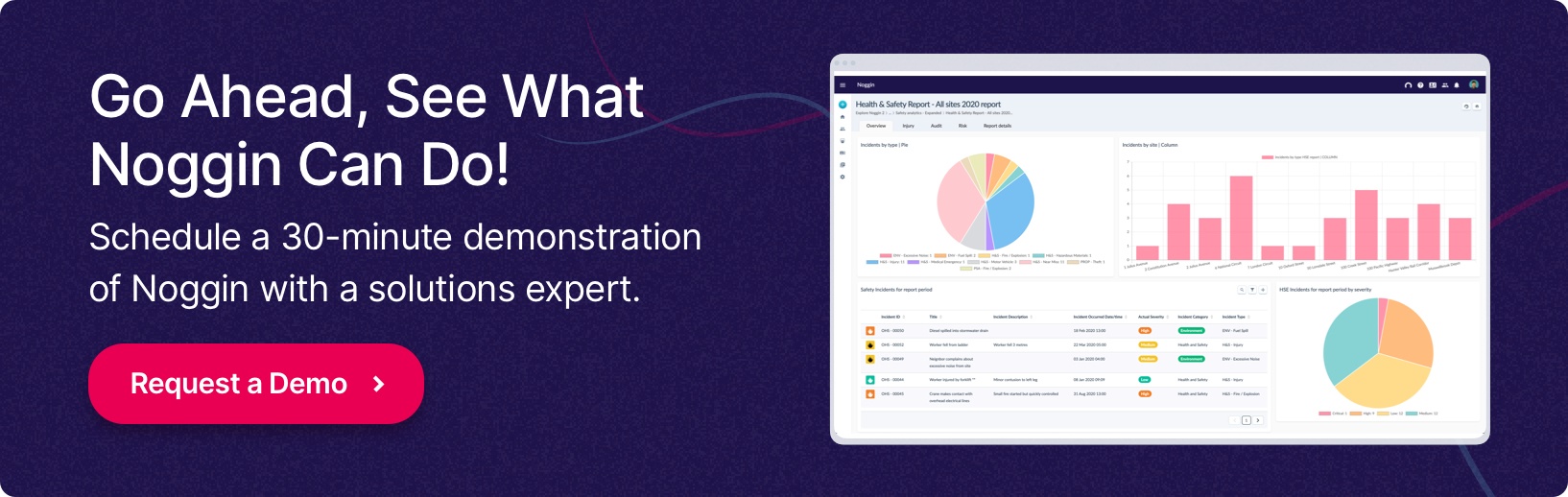
Noggin’s integrated resilience software gives manufacturers everything they need to anticipate and prepare to protect what matters and navigate disruptions with effective response and recovery. But don’t just take our word for it, request a demonstration to see Noggin in action for yourself.