


















.svg)
.svg)
.svg)
When an incident occurs, your organization must be ready to mount a thorough and rapid response to protect the safety and security of your personnel, property, or other assets. But when such an event occurs in a healthcare environment — whether it’s a hospital, assisted living facility, pharmacy, or any other workspace centered on caregiving — a poor or mismanaged response is far more likely to result in additional harm, injury, or even death.
For this reason, healthcare organizations that seek to improve incident preparedness and mitigate harmful outcomes for their patients, employees, and workspaces have come to rely on incident management systems designed specifically for the healthcare sector.
In recent years, digital tools like incident management system software have emerged as the most advanced ways healthcare organizations can proactively identify, track, manage, and analyze healthcare incidents. Solutions like these enable organizations to centralize incident response protocols, keep communication clear as incidents progress, document all events throughout incident lifecycles, and gain insights to inform future protocol improvements.
Separately, artificial intelligence (AI) and machine learning (ML) technologies have captured the attention of people around the world, prompting companies to seek tangible applications for them in nearly every sector. So, it should be no surprise that software developers are starting to look for practical uses of AI- and ML-oriented technologies in the healthcare system management space to improve these tools even more.
In this article, we’ll look deeper at some of the ways AI and ML are projected to elevate healthcare incident management software and how they deliver key support to organizations like yours, covering the types of roles they can play in healthcare system management scenarios, their potential applications in the healthcare space, and the specific benefits of incorporating AI-driven technology into your healthcare learning management system.
What is healthcare incident management?
An incident management system (IMS) is a structured system or plan designed to minimize organizational disruption, maintain operational continuity, and mitigate damage to your assets, both physical and digital, when an incident occurs. If your organization is dedicated to being as prepared as possible, an IMS is an essential element of your overall resilience strategy.
Similarly, healthcare incident management is a structured, organized process for handling adverse events in a healthcare setting that can have a negative effect on the safety or health of patients, employees, property, or other assets. A robust healthcare IMS should contain clear instructions for how teams should gain situational awareness, restore operations, communicate clearly, and document actions taken to mitigate further risk and minimize additional damage.
Since a healthcare IMS is attuned to the risk landscapes of healthcare settings, it’s designed with incident scenarios specific to these settings, in addition to common incident types that can occur anywhere. Specific healthcare incident scenarios include but aren’t limited to:
- Patient safety issues
- Medical errors
- Power or medical equipment failures
- Physical security breaches of caregiving spaces
Meanwhile, some common incident types that an IMS can help your organization manage and mitigate include:
- IT outages
- Data breaches
- Ransomware attacks or other cybercrimes
- Natural disasters
The role of AI in healthcare incident management
The most important thing to know about AI- and ML-driven technology in healthcare incident management is that it won’t operate autonomously unless enabled to do so. For healthcare incident management, AI-enabled tools are designed with a human-in-the-loop approach, in that a human is always present to interact, intervene, and use critical judgment to control or change any element of your incident response as needed.
With that in mind, there are some important things to think about when considering whether to incorporate AI-enabled digital tools into your healthcare incident management plan.
While AI-driven tools for healthcare incident management aren’t autonomous, they can perform tasks for which humans were previously responsible on an automated basis. To enable this, you would need to grant security permissions to these tools that are commensurate with the tasks you’d like it to handle.
Therefore, to best protect your patients, your organization, and any data for which you have the responsibility of security, it’s incumbent on you to perform your due diligence when evaluating AI-integrated healthcare incident management software, just as you would with any other third-party tool or solution.
Additionally, your healthcare incident management team must keep the inverse principle in mind — that AI is merely a functional part of a digital tool designed to enhance their capabilities but shouldn’t be expected to run the whole operation. Your team still bears the responsibility of making every decision, critical or otherwise, so that all parties are informed with accurate information throughout the duration of the incident until normal operations have been restored.
AI use cases in healthcare incident management
AI has dominated the tech conversation for the last 12 to 18 months, given the emergence of multiple large language model (LLM) platforms, chatbots, and other AI-driven tools with which people have increasingly interacted. But regarding healthcare incident management and healthcare system management, much of the broad practical involvement of AI remains theoretical as of publication, with only some verified use cases available.
But as AI technology is continually improving, a breakthrough can propel rigorously tested and ready-to-go functionality into the healthcare incident management and incident response spaces at any moment. And so, we’ll talk through some of the specific applications and relevant benefits of predictable scenarios for when this technology rolls out more widely for use in this sector:
Risk analysis and incident prevention
The best healthcare incident is the one that doesn’t occur at all — and the more proactively your healthcare incident management software can help you detect and defuse risk, the safer your patients, personnel, and property become. To that effect, a number of healthcare management systems have already integrated AI technologies into their offerings to assist healthcare organizations with risk analysis, scenario planning, and overall resilience.
AI- and ML-enabled healthcare incident management software analyzes complex historical datasets and runs trending data against real-time information to generate informed predictive models other adverse event forecasts. These models can then be used to inform elements of your IMS including improved patient safety protocols, equipment maintenance plans, and since incidents can never truly be prevented, incident response plans and recovery scenarios.
Theft prevention
Healthcare workspaces are prime targets for theft, whether it’s of pharmaceuticals — also called drug diversion — medical equipment, medical supplies, or other valuable assets primarily found in these physical spaces. As such, evaluating and monitoring these spaces for potential theft, as well as identifying and investigating theft when it’s discovered, have become a substantial line-item in the budget of every healthcare organization.
Industry experts estimate that most large hospitals have had to grow their diversion teams to combat these trends, putting smaller hospitals and healthcare workspaces at an inherent disadvantage for theft detection and investigation. Additionally, they confirm the existence of a pervasive “culture of silence” among healthcare workers (HCWs) that ensures that not all thefts are reported, and therefore, able to be detected and resolved using traditional methods.
The integration of AI technologies into healthcare incident manager software is expected to build on the use of digital tools that are already delivering quantifiable gains for drug diversion and other theft investigations in caregiving spaces. According to a 2025 Diversion Trends report prepared by healthcare industry news source HIT Consultant, hospitals have leveraged diversion monitoring software to conduct 61% more investigations between 2023 and 2024, with cases closing 40 days faster year over year.
Workplace violence
We’ve previously covered facts about workplace violence in healthcare settings, most notably that healthcare is among the riskiest sectors for nonfatal injuries and (highest number of) days away for workers as a result, when compared to all others. Nurses and aides who directly interact with patients have the highest risk of experiencing workplace violence, as they have the most close contact with those receiving service, but every person present at a healthcare work site has the capacity to be directly involved or indirectly affected by an incident of workplace violence.
One way healthcare organizations can strengthen their overall resiliency is through the use of security management software, which helps you gain valuable threat intelligence, enhance situational awareness, and streamline incident reporting. And according to a 2024 article by HealthManagement.org, an organization composed of healthcare executives and leaders who drive improvements in healthcare management, there are predictable and valuable ways AI is expected to enhance the capabilities of such software in years to come.
For example, once an AI-based system integrates with healthcare incident management software, it can deliver high-accuracy location tracking for spaces that are even as big as a large hospital campus, even across existing low-latency Wi-Fi- networks. When combined with wearable alerting devices, responders can be notified of incidents more quickly, access historical data for context, and receive real-time updates with ongoing developments as events unfold, all to enhance safety for everyone within that workspace.
Incident reporting & incident documentation
Like emergency response teams, healthcare incident response teams are trained to frequently compile available data into detailed reports that inform the common operating picture (COP) upon which decision-makers rely for situational awareness. These reports are critical to assisting those atop the chain of command in making informed decisions, as well as documentation that accounts for all decisions made in the course of incident response, measuring their efficacy, and making adjustments in the future.
Additionally, reporting every decision that a healthcare facility makes when dealing with an incident is an integral part of regulatory compliance, which is especially complex in the healthcare sector as it’s often managed by multiple regulatory bodies at once. Even while attempting to defuse an active adverse event, no healthcare organization seeks to become liable for noncompliance fees, or worse financial penalties, upon review of an incident that occurred at one of their workspaces.
Presently, healthcare incident management software augmented with AI and ML elements can quickly and accurately streamline the reporting process, capturing key event details in real-time and housing reports in an intuitive central space that can easily be accessed by all relevant personnel. This way, teams can share a unified COP with all team members while the team continuously meets all legal requirements for transparency and accountability.
How AI-enabled healthcare incident management software helps today
Since its use has a high likelihood of materially impacting life-and-death circumstances, AI-enabled healthcare incident management software is always being rigorously tested and has only been deployed to specific hospital systems and other areas of the healthcare sector before rolling out more broadly in a deliberate manner. The companies that produce these platforms are exhibiting the utmost caution and responsibly releasing features that they’re certain will improve incident response efficacy while maintaining compliance with all applicable regulations.
This is why Noggin’s integrated resilience solution only includes AI-enabled reporting and documentation assistance as of publication, but with plans to expand into other AI-driven capabilities that can help your organization bolster your resilience posture and be ready to assess and mitigate the damage and disruption of your next emergency as it arrives.
With a seamless AI integration, Noggin lets your healthcare incident management team quickly generate summaries or other data outputs like:
- safety alerts, to inform those directly affected or potentially in harm’s way
- current COPs, to inform critical decision-making
- executive briefs, to inform stakeholders as events unfold
- Business Impact Analyses (BIAs), to assess any further risks of disruption
- incident action plans, for uniform direction across team members
- synopses of actions taken during incident response, for full accountability
- summaries of outcomes, to measure the efficacy of actions taken
The difference between your healthcare incident management system acting and acting quickly can be the difference between safety and danger, disruption and regular order, and possibly even life and death. By generating clear, accurate content in real time for a variety of vital functions, Noggin enables your team to make informed decisions faster, communicate more effectively, and keep all parties apprised of the situation as needed, with transparency where it counts.
Most importantly, your incident response team can be equipped with the real-time information they need to stay safe while minimize disruption to the care your patients receive. Healthcare systems are only as good as their patient outcomes, which is why Noggin’s healthcare incident management software proactively works to bolster your resilience posture while helping your organization to maintain the high quality of patient care you deliver every day.
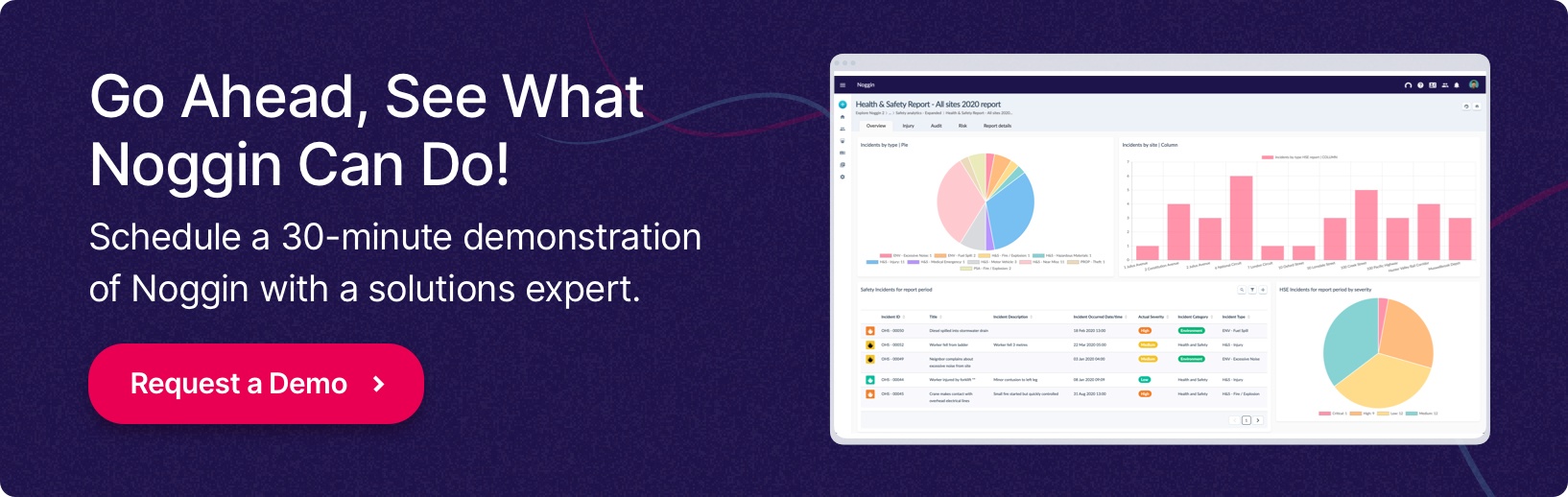
To see how your healthcare organization can better prepare for your next incident, request a demo of Noggin today and try it out for yourself.
.svg)