




















.svg)
.svg)
.svg)
Protecting places of mass gathering means controlling risk. Safety and security risk, however, can come from virtually any aspect of the operation, a daunting prospect for venue owners and operators. And that risk tends to increase – not shrink – as the size and complexity of the operation grows.

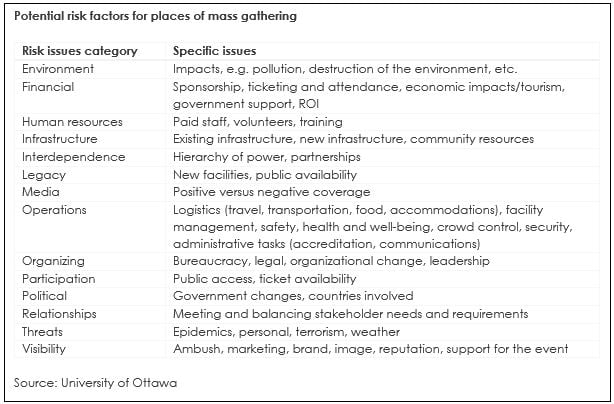
What’s more, effective risk management for protecting places of mass gathering isn’t just a best practice, recommended to venue owners and operators. Many jurisdictions have stepped in, too, mandating effective management of safety and security risk as the legal price to play for operating venues – risk factors to consider include the following:
Those mandates put venue owners and operators firmly on the hook for taking reasonable steps to ensure the protection and safety of congregating public. This legal responsibility falls under the broad banner of duty of care.
What does the duty of care obligation entail in the context of a place of mass gathering? An important component: owners and operators are obligated to consider the risk of terrorism in their security and emergency planning processes.
Oftentimes, public safety and law enforcement agencies will provide venue owners and operators with the tools to self-assess the risk of terrorism to their operation. Duty of care obligations don’t end there, though. Besides performing self-assessments, venue owners and operators are encouraged to commit to activities that will keep places of mass gathering safe. These security activities tend to be of an ongoing nature, consisting of the following:
- Maintain an awareness of the operating environment
- Provide adequate security for their assets, based on threat and risk
- Actively apply risk management techniques to their planning processes
- Conduct regular reviews of risk assessments and security, emergency, and contingency plans
- Report any incidents or suspicious activity to relevant public safety officials
- Develop and regularly review business continuity plans, including identifying interdependencies
- Conduct training and exercise their security, emergency, and contingency plans
- Participate in government exercises to assist in harmonizing prevention, response and recovery arrangements with relevant controlling agencies
Of course, precise standards vary by jurisdiction. As such, venue owners and operators are well advised to consult the relevant local, state, and federal statutes.
A typical baseline, though, is the expectation that people won’t be exposed to risks arising from the operation. Complying with that obligation will entail different steps for different operations. For instance, for major-event organizers, compliance means taking proactive steps to keep public safe before, during, and after an event. Conversely, for venue owners and operators of places of mass gathering, compliance means taking proactive steps for the length of the operation.
How to get it right? Effective, integrated safety and security management planning helps mitigate risk and keep public and property safe.
To learn more, download our guide to protecting places of mass gathering.

For more news and updates, follow @teamnoggin on Twitter
.svg)