




















.svg)
.svg)
.svg)
Business process management implementations, useful as they are, aren’t ends. They’re means. Organizations engage in those implementations to effect larger transformations. After all, businesses are looking to gain concrete outcomes, results like better alignment, increased agility, flexibility, and innovation, cost reduction, deprecation of legacy applications, better compliance management, etc. The question is: how can workflow automation help organizations secure those business benefits?
Well, transformation initiatives, to be effective, must first propel change in underlying (and supporting) business processes. As experts in the field put it: “Fundamental to enterprise transformation is the interplay between overarching goals of transformation and the fundamental work processes that drive an enterprise.” In other words, transformation initiatives give companies the opportunity to improve how work is currently done. Alternatively, they give organizations the chance to do different, smarter work in the future.

And that’s where workflow management come in. Workflow management provides concrete techniques for implementing and automating business processes, often driving immediate efficiencies. In fact, workflow management can deliver process improvements and greater flexibility just by merely supporting the formal description and analysis of business processes.
What other benefits? Well, when it comes to business transformation, the data shows that the actual transformation initiatives aren’t very successful: their costs high; the returns low. According to research from McKinsey and Oxford University, a paltry 30 percent of transformation initiatives actually succeed over the long term. Similarly, large IT projects deliver 56 percent less than value than initially predicted. Workflow automation can help.
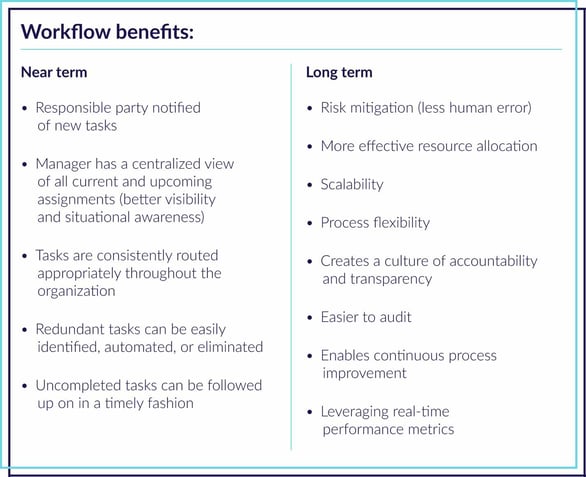
Workflow management solutions tend to be major drivers of lower operational and labor costs, usually because workflow automation eliminates redundancies, centralizes implementations, and leads to fewer errors, better communication, and improved decision making. What’s more, the process improvements that workflow automation deliver also create their very own revenue streams. Here is a more detailed list of workflow benefits:
So what workflow functionality should you be looking for to achieve those automation benefits? Download our comprehensive guide to find out.

Sources:
James Caverlee et al, Information Knowledge Systems Management: Workflow management for enterprise transformation.
For more
.svg)