
Request a Demo
Fill in the form below and we will contact you shortly to organised your personalised demonstration of the Noggin platform.

Meet Noggin
An integrated resilience workspace that seamlessly integrates 10 core solutions into one, easy-to-use software platform.





The Noggin Platform
The world's leading integrated resilience workspace for risk and business continuity management, operational resilience, incident & crisis management, and security & safety operations.

Industries
Explore Noggin's integrated resilience software, purpose-built for any industry.











A Resilience Management Software Buyer's Guide

Who We Are
The world’s leading platform for integrated safety & security management.

.svg)
.svg)
.svg)
The unsafe work of transportation
The transportation and logistics sector has traditionally been one of the country’s most dangerous, particularly road transport. Due to serially high rates of work-related fatalities and injuries and illnesses, the Australian Work Health and Safety Strategy 2012-2022 singled the industry out as a priority sector for its national prevention efforts. Those initiatives sought to reduce the incidence of serious injury by at least 30 percent nationwide and the number of work-related fatalities (due to injury) by at least 20 percent by the year 2022i.
How have things progressed since? Well, the sector retains the highest rates of fatality (15.6 fatalities per 100,000 workers) and frequency (11 per million hours worked)ii. Road transport also clocks in the second highest (raw) number of fatalities, with no improvement in recent years. Serious claims remain high, as well, with 11 serious claims logged per million hours workediii.
Within the broader industry, road freight represents the biggest offender. The subsector accounts for some 92 percent of worker fatalities and 82 percent of serious claimsiv. Occupationally, truck drivers are at greatest safety risk. Both their fatality (84 percent) and serious claims (54 percent) numbers are highestv.
If truckers are at greatest safety risk, the road is the greatest risk vector. For the entire sector, nearly 80 percent of worker fatalities involve vehicle incidents, with “being hit by moving objects” in a distant second with 6 percent of fatalitiesvi.
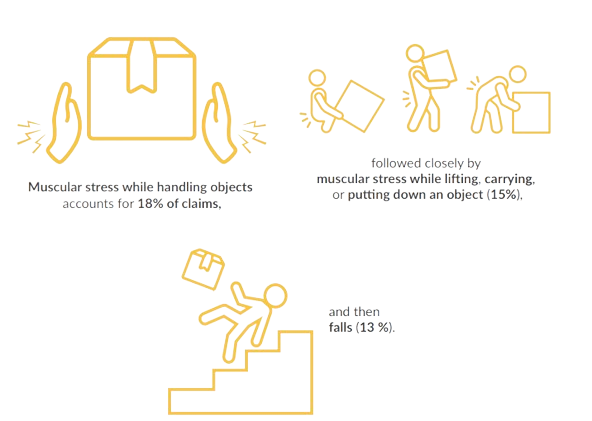
Serious claims statistics round out the risk picture. Muscular stress while handling objects accounts for 18 percent of claims, followed closely by muscular stress while lifting, carrying, or putting down an object (15 percent), and then falls (13 percent)vii.
Serious claims statistics
Who is responsible?
The high risk of workplace incidents and accidents remains a perennial challenge for the industry – from fatigue management, failure to conduct proper walkarounds, slips and falls, even the pressure to work in unsafe conditions. But the question is, who is to blame?
Historically, the duty to ensure the safety of transport activities fell to drivers and operators alone. But policymakers in the middle-2010s began to think that the obligation was entirely too narrow. The thinking went: any number of actors participate in the transport supply chain. Their behaviour is highly likely to influence the action of truckers; should they not bear responsibility, as well? Something had to change.
The main federal statute to change is the one governing the safety of commercial roadways (heavy vehicles of 4.5 tonnes gross vehicle mass): the Heavy Vehicle National Law (HVNL), administered by the National Heavy Vehicle Regulator (NHVR). Having gone into force in February 2014, the HVNL is broadly applicable in the Australian Capital Territory, New South Wales, Queensland, South Australia, Tasmania, and Victoria, who have all fully adopted or slightly modified the law at the state/territory level (See below).
As such, a version of the HVNL applies to commercial vehicles from Western Australiaviii and Northern Territory once they cross state/territory borders. Western Australia, though, regulates fatigue management under the Occupational Safety Act 1984, while the Northern Territory regulates heavy vehicles under the Motor Vehicles Act 2011.
What are the laws of the land? Applications of the HVNL in states and territories.
| Jurisdiction | Act | Regulations |
| ACT | Heavy Vehicle National Law (ACT) Act 2013 | Heavy Vehicle National Law (ACT) (Transitional Provisions) Regulation 2014 |
| NSW | Heavy Vehicle (Adoption of National Law) Act 2013 | Heavy Vehicle (Adoption of National Law) Regulation 2013 |
| Queensland | Heavy Vehicle National Law Act 2012 (Qld) | Heavy Vehicle National Law Regulation 2014 |
| South Australia | Heavy Vehicle National Law (South Australia) Act 2013 |
Heavy Vehicle National Law (South Australia) (Expiation Fees) Regulations 2013 Heavy Vehicle National Law (South Australia) (Fees) Regulation 2013 |
| Tasmania | Heavy Vehicle National Law (Tasmania) Act 2013 | Heavy Vehicle National Law (Tasmania) Regulations 2014 |
| Victoria | Heavy Vehicle National Law Application Act 2013 | Heavy Vehicle National Law Application (Infringements) Regulations 2013 |
Source: National Vehicle Regulator
How has the HVNL changed?
In recent years, though, the HVNL has evolved to embrace new thinking on how to manage safety risk, best articulated in Section 17 of the federal Work Health and Safety Act. Devoted to the management of risk, the section clarifies what constitutes a duty imposed on a person to ensure health and safety. The duty requires a person to:
- Eliminate risks to health and safety, so far as is reasonably practicable; and
- Minimise those risks so far as is reasonably practicable, if it is not reasonably practicable to eliminate risks altogetherix.
So, then, what is reasonably practicable to ensure health and safety? Australian work health safety legislation requires organisations to reduce risks to as low as is reasonably practicable, a British legal principle that’s leads to a slightly different interpretation of risk management than what’s typically taken by OHS professionals internationally. Under the current legal regime, Courts take the stance that if the consequences of a risk are severe then the organisation must take reasonable steps to mitigate those consequences, regardless of the likelihood of that risk occurring.
The WHS Act goes on to define it as that which is “reasonably able to be done in relation to ensuring health and safety, taking into account and weighing up all relevant matters,” including the following:
- The likelihood of the hazard or the risk concerned occurring
- The degree of harm that might result from the hazard or the risk
- What the person concerned knows, or ought reasonably to know, about:
– the hazard or the risk
– ways of eliminating or minimising the risk - The availability and suitability of ways to eliminate or minimise the risk
- After assessing the extent of the risk and the available ways of eliminating or minimising the risk, the cost associated with available ways of eliminating or minimising the risk, including whether the cost is grossly disproportionate to the riskx.
That sort of thinking has migrated into the HVNL via the idea of a chain of responsibility, a purposeful attempt by policymakers to fan out these proactive obligations to a wider cohort of actors, or “chain of responsibility”.
A conscious effort to bring the HVNL in greater alignment with existing WHS law, the “chain of responsibility” amendment came into effect in late 2018. It imposes on the entire supply chain a legal obligation to ensure that breaches of the HVNL do not occur.
How to comply: simply by doing all that is reasonably practicable to eliminate and/ or minimise risk to activities associated with heavy vehicle transport, as well as be able to demonstrate that you have discharged your duty in identifying, assessing, and managing risks.
A deep dive on chain of responsibility
The key change chain of responsibility introduces is a wider list of actors responsible for ensuring safety. So, the logical question to ask is, who exactly is involved in the safe transport of goods? Well, chain of responsibility is applicable to the following supply-chain participants:
- An employer of a driver
- A prime contractor for the driver – if the vehicle’s driver is self-employed
- An operator of the vehicle
- A scheduler for the vehicle
- A loading manager for any goods in the vehicle
- A loader and/or unloader of a vehicle
- A consignor of any goods for transport by the vehicle
- A consignee of any goods in the vehicle
- A loader and/or unloader of any goods in the vehiclexi.
Who are consignors and consignees?
You are a consignor if:
- You have agreed to and been named as a consignor in the documentation for the road transport of the goods.
- You request an operator of the heavy transport vehicle (directly, indirectly or through their representative) to transport the goods by road.
- You load a vehicle with the goods (and the goods are in your possession or control) immediately before the operator transports them
- You or your transport provider load a heavy vehicle with the goods for road transport at an unattended storage/collection location.
- The goods are imported into Australia, and you are the importer
You are a consignee if:
- You have agreed to and been named as a consignee in the documentation for the road transport of the goods;
OR - You receive the goods after road transport (but not merely the unloader).
Handy checklists put out by the NHVR help parties identify the role (or roles) they play in the transport operationxii. Once those parties have done so, though, they are on the hook legally for complying with the HVNL.
As we mentioned, compliance with the HVNL entails identifying, assessing, evaluating, and controlling transport safety risk, wherever possible. In addition, all relevant risk management practices taken to manage safety must be documented as another proof of compliance. Regular reporting is also mandated, including to executive officers.
The broader challenge to compliance, however, is that chain of responsibility will mean different things to different supply-chain actors – some actors will occupy multiple roles in the supply chain. Fulfilling your safety duty will then depend on relative levels of safety risk. Those levels vary; for instance, owning or contracting heavy vehicle services will inhere different levels of risk.
So, what to do? The best way to go about compliance is adopting a safety management system (SMS) to help effectively consider and manage day-to-day safety risk. Not familiar with the SMS concept? Here are the relevant principles which will help you comply with chain of responsibility:
Safety policy
Formalises management’s commitment to safety and expresses the organisation’s safety philosophy. The safety policy itself should adumbrate the methods and processes the organisation will implement in order to reach desired safety outcomes.
A typical policy will contain the following commitments by senior leadership: implement and appropriately resource the SMS, ensure continual safety improvement, and make safety the highest priority. Another aspect of safety policy involves the encouragement of employees to report safety issues without fear of reprisal.
And of course, written within the larger safety policy should be guidance about the responsibilities of all key personnel, including the Safety Manager.
Safety risk management
The fundamental component of SMS, which we tackle below.
Safety assurance
A means to systematically assess how well the organisation is meeting its safety objectives. Safety assurance includes the rudiments of an effective audit program, consisting of self- and external auditing, as well as safety oversight.
The program itself should have developed safety indicators and targets, as well as the ability to monitor adherence to safety policy through self-auditing – these components help validate the overall SMS, with safety performance monitoring, in particular, enabling management to pursue continuous improvements in safety management.
Further, the Safety or Risk teams should solicit input through a non-punitive safety reporting system. Included in that system will be all available feedback from daily self-inspections, assessments, reports, safety risk analysis, and safety audits. Finally, a key objective of safety assurance is to communicate safety findings to staff and implement mitigation strategies once they are agreed upon.
Safety promotion
Includes safety training and education, communication, competency, and continuous improvement. Safety training, the responsibility of the Safety Manager, exemplifies management’s commitment to the safety function. Best-practice training programs (always recurrent, never one-and-done) will include a documented process to identify training requirements and a mechanism by which the effectiveness of the program can be measured.
What’s more, the training should be job- and site-specific (i.e. fits the needs and complexities of the supply chain), combining human and organisational factors, as well as incorporating the SMS.
Communication is another key component of safety promotion. Operators and managers should broadly disseminate safety goals and procedures. The SMS itself should be readily apparent throughout the transport operation, with bulletins, briefings, and trainings reinforcing the health of the SMS. The dissemination of lessons learned (both internal and external) should not be neglected. Along those lines, staff should be actively encouraged to identify potential safety hazards and propose solutions.
Safety risk management
Involves a lifecycle, which spans five phases: describe the system, identify hazards, determine risk, assess and analyse risk, and treat (or control) risk. Here’s what each means:
- Describe the system. Safety risk management isn’t distinct from existing safety functions. In fact, those functions help focus risk management analysis and inform potential mitigation strategies.
- Identify the hazards. In a transport environment, operations, equipment, people, and procedures can all pose hazards to the system. These hazards must be identified in a systematic way, leaning on existing operational expertise and hazard analysis tools, as well as safety management training and adequate documentation.
- Determine the risk. At this point, identified hazards are documented, in advance of determining their possible severity, i.e. whether the hazard is a risk.
- Assess and analyse the risk. Risk assessment depends on first independently determining severity (the worst credible potential outcome) and probability. These will likely be subjective or qualitative determinations.
Once assessed, the risk is analysed, scored using a matrix of severity and likelihood. Most risk matrices include the following levels: high (or unacceptable level of risk), medium (or acceptable level of risk), and low (or acceptable level of risk without restriction or limitation). Low risk is the target level of risk, since eliminating risk altogether is not always practicable or advisable. - Treat the risk. The risk matrix determines the priority in which risks are treated. High risk items must be dealt with first. Here, typical risk management activities include avoidance, assumption, control, or transfer.
Mitigation strategies themselves must be validated and verified before implemented. Part of that verification entails measuring the effect of the proposed course on the underlying risk; this process can be repeated until it yields a measure (or combination of measures) that reduce risk to an acceptable level.
Finally, implementing a risk mitigation strategy will often require approval, cost-effective funding, and scheduling. But implementation isn’t the end of the story. Hazard tracking remains key, until the risk is mitigated to an acceptable level. Still, the record of the hazard must be maintained.
What are the penalties for non-compliance?
Implementing a best-practice SMS is the surest way to comply with your chain or responsibility obligations. But say you don’t comply. What are the penalties for breaches of safety duty?
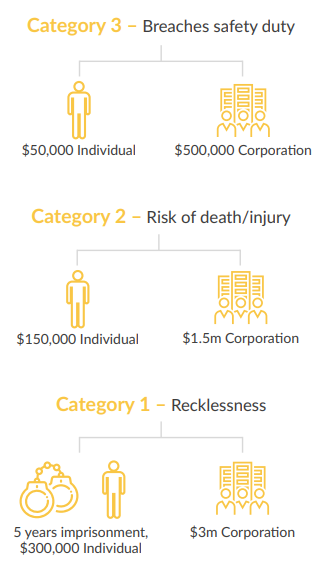
New penalties are severe, another attempt to harmonise the HVNL with WHS legislation, as now maximum fines are similar. Executive officers are also now liable for safety breaches. The three tiers of fines are as follows:
Finally, chain of responsibility introduces new safety compliance risk to the entire transportation and logistics sector, already one of the highest risk industries. Finally, the safety management system alone isn’t enough to maximise safety benefits and ensure compliance. Instead, mitigating safety risk and making better informed safety decisions (should risks become incidents) require actors to develop best-practice safety risk management programs across the supply chain, and operationalise those programs by implementing advanced, integrated and safety risk management software, like Noggin Safety
Citations
i Safe Work Australia. Available at https://www.safeworkaustralia.gov.au/transport.
ii Ibid.
iii Ibid.
iv Ibid.
v Ibid.
vi Ibid.
vii Ibid.
viii Western Australia has subsequently implemented the Harmonised Work Health Safety (WHS) Legislation
ix Australian Government, Federal Registrar of Legislation: Work Health and Safety Act 2011. Available at https://www.legislation. gov.au/Details/C2017C00305.
x Ibid.
xi NHVR: Chain of Responsibility checklist. Available at https://www.nhvr.gov.au/files/201703-0484-cor-check-list.pdf.
xii Ibid.
.svg)
Download your copy
About this Article
Published: 25 March 2024