
Request a Demo
Fill in the form below and we will contact you shortly to organised your personalised demonstration of the Noggin platform.

Meet Noggin
An integrated resilience workspace that seamlessly integrates 10 core solutions into one, easy-to-use software platform.





The Noggin Platform
The world's leading integrated resilience workspace for risk and business continuity management, operational resilience, incident & crisis management, and security & safety operations.

Industries
Explore Noggin's integrated resilience software, purpose-built for any industry.











A Resilience Management Software Buyer's Guide

Who We Are
The world’s leading platform for integrated safety & security management.

.svg)
.svg)
.svg)
Executive summary
Like most other modern economies, the United Arab Emirates (UAE) faces significant threats to resilience. For instance, the Allianz Risk Barometer 2025 ranks cyber incidents and business interruption among the top risks to enterprises in the MENA region. To combat these threats, organizations operating in the UAE require robust business continuity management systems (BCMS).
AE/SCNS/NCEMA 7000:2001 is the nation’s BCMS standard, designed to enhance the resilience of the UAE business community. Closely aligned with ISO 22301, the standard, applicable to all organizations, mandates a systematic approach to business continuity.
Therefore, this guide, targeted at boards of directors, senior and executive management, business owners and owners of information assets, business continuity managers, and internal auditors, examines the standard’s key requirements.
And since AE/SCNS/NCEMA 7000 compliance is key to ensuring the continuation of essential operations during and after a disruption, the guide will demonstrate how Noggin’s business continuity software helps simplify, streamline, and automate the standard’s complex requirements, aiding organizations in preparing for and responding to adverse events.
Introducing AE/SCNS/NCEMA 7000:2001
Like their peers globally, organizations across the MENA region are experiencing an uptick in resilience threats. The Allianz Risk Barometer 2025 ranks cyber incidents and business interruption high among the region’s top risks.
Even the United Arab Emirates (UAE), ranked the safest and most economically resilient place in the world to do business in the World Security Report, is facing the pressure stemming from this threat environment.
For instance, in April 2024, unprecedented heavy rains caused heavy flooding throughout the region, with the UAE particularly hard hit. The severe weather event caused closures and severe delays at major transport hubs in addition to overwhelming stormwater networks, disrupting power to commercial districts, and forcing road closures.
Meanwhile, in June 2025, severe regional tensions came to a head, leading to the temporary closure and rerouting of Middle Eastern airspace. Again, major transport hubs in the UAE were impacted and had to activate their emergency contingency plans to handle cancellations, delays, and rerouting.

Flooding at Al Mizhar in Dubai, April 2024. Photo source.
The rising cost of these types of disruptions significantly exacerbates the pressure local organizations are facing, as well. According to the Cost of a Data Breach Report, the average cost of a data breach for Middle Eastern businesses rose nearly 10% year-on-year, hitting SAR32.80 million ($8.74 million) in 2024. The increase was driven by such factors as, the shortage of security skills, the complexity of security systems, and non-compliance with regulatory standards.
Mitigating the impacts of these incidents calls for staff mobilization and regulatory coordination. But to ensure organizations are taking a proactive business continuity posture, UAE regulators have developed standards to ensure the resilience of the organizations and agencies operating in the jurisdiction. Applicable to organizations in all sectors, AE/SCNS/NCEMA 7000:2001 is one such standard.
Modelled closely on international standard ISO 22301, AE/SCNS/NCEMA 7000 is the national standard for business continuity management systems (BCMS) for the UAE.
The agency behind AE/SCNS/NCEMA 7000
Who established the standard? The agency behind AE/SCNS/NCEMA 7000 is the National Emergency Crisis and Disasters Management Authority (NCEMA) which works under the umbrella of the National Supreme Security Council.
In that capacity, the agency supervises and administers compliance with national policy regarding emergency, crisis, and disaster management procedures. Among its chief, strategic objectives is achieving security and resilience.
That’s where business continuity management comes in. NCEMA serves as the exporter and legislator of AE/SCNS/NCEMA 7000, making the agency responsible for monitoring the standard’s implementation at the federal and local level.
AE/SCNS/NCEMA 7000: Introductory sections
AE/SCNS/NCEMA 7000, which is applicable to all UAE entities, requires organizations to maintain their essential operations within pre-defined minimum acceptable delivery levels for their products and services.
The introductory sections on governance and context of the organization largely echo concepts found in ISO 22301. A dedicated section on management system planning instructs organizations to plan not only the implementation process but also set target dates for the system’s completion. And the standard further directs organizations to:
- Establish a process for determining their context
- Identify issues relevant to their purpose, strategic direction, and business continuity objectives
- Identify interested parties and determine their needs and expectations, including all legal and regulatory requirements
- Require top management to define the acceptable level and type of risk the organization will take, and ensure that the corresponding risk criteria are developed and communicated to the entire organization and its interested party
Section: Policy, Scope, and Objective
According to the standard, business continuity policy establishes top management’s intent and direction for the management system, providing a crucial framework for subsequent decision-making. Clearly defining the policy, scope, and objectives helps to ensure that staff, customers, and other interested parties understand top management’s commitment.
For this reason, AE/SCNS/NCEMA 7000 requires complying organizations to create and maintain a documented statement that defines the organization's:
- Business continuity policy
- Scope of the management system
- Business continuity objectives
This statement must then be communicated to all workers as well as interested parties.
The scope of the BCMS is meant to clarify coverage for interested parties. Any exclusions must, therefore, be explained and justified to provide assurance that they will not undermine overall business continuity.
Following this logic, the organization must establish a process for defining the management system’s scope in terms of the products and services to be included. This scope must be appropriate to the organization's context and clearly identify the BCMS's boundaries and applicability.
Section: Management system support
This section addresses management system support, covering essential areas like people (competence and awareness), resources, external providers, communication, and control over system changes.
This section reinforces the factors that make a management system effective. These factors include:
- Planning. The system must be well-planned.
- Integration. Processes should be integrated with other business functions.
- Commitment. The system must have the commitment of top management.
- Resources. The system requires necessary resources (e.g., budget, data, facilities, technology, etc.) to achieve business continuity objectives.
- External providers. Effective communication with external providers must be maintained.
- Competence. People in key roles must possess the necessary competence.
- Awareness. Employees must understand their role in achieving organizational goals.
- Change control. All changes must be controlled.
- Documentation. Suitable documentation and records must be retained.
The standard mandates establishing a specific process for communication during disruptions. This process should include:
- Identifying both internal and external parties for communication
- Determining, for each party, the information to be shared, the timing, the methods of delivery, and the person responsible for communication
A similar process must be established to communicate changes that affect the management system. This process should include:
- Identifying the changes
- Evaluating the effect of changes on the overall management system performance
- Determining the necessary actions to be taken
Section: Documented information
Documented information is the term used to describe the records and procedures that an organization must control and maintain. This information must be locatable, accessible, identifiable, understandable, and readable. It may, however, be presented in any format or style the organization deems acceptable.
Organizations need two key processes for handling this information:
- Creation. A process for creating documented information that covers its format and appropriate media
- Control and updating. A process for controlling and updating documented information, covering distribution, storage, retrieval, preservation, and revision
Documented information should also include the following elements:
- Management system roles, responsibilities, and planning
- Organizational issues, interested parties, and risk attitudes
- Policy, scope, and objectives
- Management system support (e.g., people, resources, external providers, communication, and change control)
- BCMS operations
- Monitoring and measuring system effectiveness
- Compliance and audit results
- Management review findings
- Identification of nonconformity and corrective actions
Section: BCMS operations
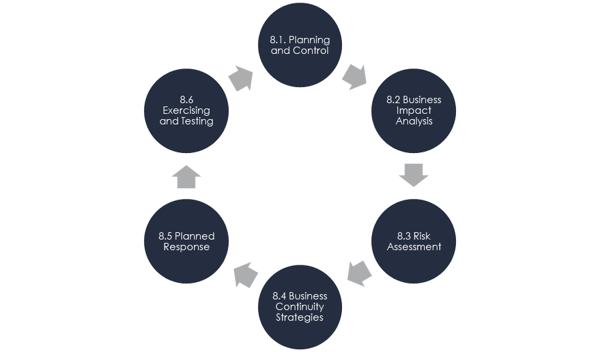
For organizations reading AE/SCNS/NCEMA 7000, the core focus of the Operations section is establishing a comprehensive business continuity plan to handle disruptions that could prevent the organization from meeting its objectives.
To this end, the standard outlines the following key steps for implementing business continuity:
- Impact analysis. Understand the different impacts resulting from activity disruptions.
- Activity identification. Identify which activities, if disrupted, would cause the most damaging impacts.
- Prioritization. Focus efforts and resources on these high-priority activities.
- Risk evaluation. Assess the risks to high-priority activities and their dependencies.
- Resource identification. Determine the resources necessary for the timely resumption of high-priority activities.
- Resumption planning. Plan when and how to resume high-priority activities.
Reading further, the standard advises organizations to plan and implement processes for BCMS operations, with the Business Impact Analysis (BIA) being foremost. The BIA's purpose is to identify the organization's high-priority activities.
The prescribed process for analyzing the business impact of disrupted activities is as follows:
- Analyze impacts. Use impact categories and timeframes relevant to the organization's context to analyze the consequences of disruption.
- Set objectives. Determine the point in time when the impact of not resuming an activity becomes unacceptable and set a Recovery Time Objective (RTO) for its resumption within that period.
- Determine capacity. Determine the minimum capacity at which activities must be resumed.
- Identify prioritized activities. Use the analysis results to identify the organization’s "prioritized activities," which require business continuity strategies to ensure resumption within the predefined RTO.
- Identify dependencies. Identify all dependencies for prioritized activities, including people, resources, external providers, and other activities necessary for product and service delivery.
In addition to developing a BIA, an organization must reduce its risk of disruptions. Here, the risk assessment provides data to identify strategies for reducing both the likelihood and impact of disruption.
As a result, the risk assessment process should identify, analyze, and evaluate the risk of disruption to the organization’s prioritized activities. This process includes:
- Risk identification. Identify risks stemming from threats and vulnerabilities relevant to the organizational context.
- Risk analysis. Analyze risks by considering potential causes, sources, likelihood, and anticipated consequences.
- Risk evaluation. Evaluate risks to determine their overall significance to the organization.
Having identified prioritized activities and dependencies, the organization must protect them by planning for their inevitable disruption. The organization, therefore, needs to consider strategies for:
- Mitigation. Reducing the risk of prioritized activities being disrupted
- Containment. Keeping the duration and impact of any disruption to a minimum
- Resumption. Resuming essential operations within acceptable timeframes
- Communication. Ensuring effective communication throughout an incident
Planned response to disruption
The BCMS operations section also addresses the critical requirement for a planned response when a disruption occurs. An organization must identify potential disruptions and prepare to respond effectively.
The primary resource for managing a disruption is the response team. And so, to be effective, the organization must create a suitable team structure, ensuring members have the necessary responsibility, authority, and competence.
Team members must operate using a pre-written structure detailing the information they need and the actions they must take. Management is responsible for assigning titles to this structure (e.g., Business Continuity Plan, Incident Response Plan, Disaster Recovery Plan) and deciding on the number, style, and level of detail, all of which must be appropriate for the organization and its workforce.
At a minimum, the established response structure must address the following elements:
- Command and control. A central team with the capability and authority to make prompt, appropriate decisions and communicate them effectively
- Incident detection and immediate response. Procedures for quickly identifying an incident and initiating the first response actions
- Communication. Protocols for internal and external communication during the disruption
- Technology recovery. Plans for recovering critical technology systems
- Activity resumption. Procedures for resuming prioritized activities
- Return to normal. Steps to transition back to normal business operations
Exercising and testing BCMS operations
The final sub-section covering BCMS operations discusses exercising and testing, which are essential for providing assurance that strategies and response structures are both effective.
A practical way to begin the process is to conduct team walk-throughs of the response structure and its requirements.
What’s the difference between exercises and tests, though:
- Exercises are typically used to develop teamwork, competency, confidence, and knowledge among those involved.
- Tests are generally used to determine if a specific outcome is achievable (e.g., confirming a technology system can be recovered within its target time).
Section: Review and evaluation
The most effective way to ensure that business continuity remains appropriate and effective is to measure the performance of the management system and confirm that all processes are correctly implemented and maintained. And so, the penultimate section of the standard mandates the review and evaluation of the BCMS.
More specifically, the standard requires organizations to have a dedicated process for evaluating the performance and effectiveness of the management system. This process should include:
- Defining targets. Identifying exactly what needs to be monitored and measured
- Methodology. Identifying the ways and means (methods) to monitor and measure performance
- Timing. Specifying and justifying the required timing and frequency of monitoring
- Analysis and reporting. Analyzing, evaluating, and reporting the results of monitoring and measurement activities
- Disruption review. Analyzing the outcomes of any actual disruptions
To keep management informed of the BCMS's effectiveness, the standard recommends measuring the organization's degree of compliance with the following BCMS elements:
|
BCMS element |
Compliance indicator |
|
Governance and policy |
|
|
Context and risk |
|
|
Strategies and resources |
|
|
Response and recovery |
|
|
Maintenance |
|
Section: Continual improvement
As with ISO 22301, the final section of AE/SCNS/NCEMA 7000 focuses on continual improvement, i.e., enhancing the efficiency and effectiveness of the BCMS. To achieve this, the organization must actively respond to nonconformities and implement corrective actions.
Rather than unsystematically, the organization must establish a regular process for identifying nonconformities and taking action to control and correct them. This process should include:
- Root cause analysis. Reviewing the nonconformity to determine its underlying cause
- Preventive assessment. Determining if similar nonconformities exist or could potentially occur elsewhere
- Corrective action. Taking the appropriate corrective actions
- System change. Modifying the management system as necessary
- Documentation and review. Recording the results and reviewing the effectiveness of the corrective action taken
This entire process is intended to address deficiencies in the BCMS and ensure it functions as intended. Consequently, the organization must also have a process for taking corrective action in a timely manner to eliminate the causes of nonconformity and prevent their recurrence.
Benefits of implementation
As demonstrated, AE/SCNS/NCEMA 7000 provides organizations with a structured approach to managing disruptive incidents. Beyond ensuring operational stability, compliance with this national standard offers several significant advantages that enhance an organization's market position, regulatory standing, and overall resilience.
- Regulatory alignment. Achieves adherence to the UAE's national requirements, which strengthens organizational credibility and mitigates the risk of non-compliance penalties
- Operational capability. Systematically establishes and maintains a business continuity framework, ensuring the organization can consistently meet its operational needs and obligations
- Enterprise resilience. Implements robust strategies that enable the organization to rapidly adapt, respond, and recover from disruptions, thereby minimizing financial losses and operational downtime
- Stakeholder trust. Builds significant confidence and trust among employees, customers, investors, and regulators by visibly demonstrating preparedness and resilience capabilities
- Market competitiveness. Provides a competitive advantage by aligning the organization with national and international best practices, highlighting a proactive commitment to business continuity on a global scale.
How Noggin helps you implement the standard
Of course, realizing the benefits of AE/SCNS/NCEMA 7000 requires more than just tick-the-box compliance. Instead, organizations must full implement a proactive BCMS in the spirit of the standard.
How to do so expeditiously? Noggin’s business continuity software, which already conforms with ISO 22301, can help.
Here’s how:
|
AE/SCNS/NCEMA 7000 Clause |
Noggin Feature |
|
8. BCMS Operations |
|
|
8.1. Planning and control |
|
|
8.2 Business impact analysis (BIA) |
|
|
8.3 Risk assessment (RA) |
|
|
8.4 Business continuity strategies |
|
|
8.5 Planned response |
|
|
8.6 Exercising and testing |
|
|
9. Review & Evaluation |
|
|
9.1 Monitoring and measuring effectiveness |
|
|
9.2 Compliance and internal audit |
|
|
9.3 Management review |
|
|
10. Continual Improvement |
|
|
10.1 Nonconformity |
|
|
10.2 Corrective actions |
|
Finally, the risk of disruption is a growing global challenge, with organizations in the Middle East facing a particularly complex risk environment.
To prepare effectively, UAE organizations should adopt the systematic approach to maintaining business continuity proposed by AE/SCNS/NCEMA 7000. The standard provides the necessary structure to secure the flow of critical functions and services through full recovery from an emergency, crisis, or disaster.
But thanks to Noggin, implementation doesn’t have to be a slog. Streamlined, integrated, and automated business continuity management, Noggin makes achieving compliance simpler, efficiently preparing organizations to handle adverse events and disruptions in the process.
But don’t just take our word for it. See for yourself how Noggin can simplify your compliance and resilience efforts. Request a demo today to learn more.
.svg)
Download your copy
About this Article
Published December 5, 2025