

Australia’s 2024 SOCI amendments extended regulator directions to all-hazards incidents, raising the bar for energy providers. Our buyer’s guide breaks down the resilience and business continuity capabilities to look for, from business impact analysis to real-time incident response.
Spanning traditional resources and renewables, the energy industry is integral to the global economy. Australia’s oil and gas industry alone supports around 80,000 jobs across its entire value chain, according to the Australian Petroleum Production and Exploration Association (APPEA). The products it brings to market are essential to the smooth functioning of society.
That criticality explains why it’s so important for asset owners and operators to keep their organizations resilient to all hazards and threats. However, hazards and threats are manifold. What's worse, they've not only been increasing but also intensifying.
Key resilience threats to energy providers
What are the key resilience threats to energy providers and their assets? They include:
Natural disasters
As their assets are spread across diverse terrain, natural disasters are a perennial challenge for energy providers. The World Economic Forum’s Global Risks Report 2026 ranks extreme weather events as the most severe global risk over the next 10 years, and the fourth most severe over the next two.
Cyberattacks
The industry also faces acute cyber risk. In fact, in FY2023–24, the Australian Signals Directorate's (ASD) Australian Cyber Security Centre (ACSC) ranked electricity, gas, water and waste services as the most-reported critical infrastructure sector–30% of the cybersecurity incidents ASD responded to that year.
Cyber espionage
Incidents of cyber espionage and cyber warfare are also on the rise. This is use of cyber weapons and tools by state and non-state actors to gain control over a digital presence, cause operational disruption, and/or compromise or damage an entity's technological and information networks and infrastructure.
The WEF's Global Risks Report 2025 ranked cyber espionage and warfare – encompassing defensive and offensive cyber operations as well as cyberattacks that steal classified or sensitive data or intellectual property – as a top five risk in its list of two-year threats.
Industry is concerned, as well. A staggering 71% of Chief Risk Officers responding to the WEF's 2024 Chief Risk Officers Outlook expressed concern about cyber risk and criminal activity severely impacting their organizations.
Mounting compliance risk for energy providers
National governments share these concerns. As a result, global policymakers have built robust frameworks for managing the security risks to vulnerable critical infrastructure assets.
Australia leads the pack with its Security of Critical Infrastructure (SOCI) Act, first passed in 2018.
Obligations on energy providers have only increased since then. In November 2024, the Australian Parliament passed the Cyber Security Legislative Package, comprising:
- Cyber Security Act 2024
- Intelligence Services and Other Legislation Amendment (Cyber Security) Act 2024
- Security of Critical Infrastructure and Other Legislation Amendment (Enhanced Response and Prevention) Act 2024
This last Act introduced a litany of SOCI Act reforms:
- Clarify existing obligations for systems holding business-critical data
- Enable government to better manage the impacts of all-hazards incidents on critical infrastructure
- Empower government to direct entities to address deficiencies in their risk management programs
- Bring regulation of telecommunications security into the SOCI Act
While the SOCI Act applies only to Australia, its all-hazards approach does offer a critical security best practice that energy providers can adopt wherever they operate.
Practical solutions to the risk environment
The Cyber and Infrastructure Security Centre recommends taking an all-hazards approach to risk management, preparedness, and planning. For energy providers, this means addressing both human-induced threats and the natural and environmental hazards that could affect the entity and its operations.
Indeed, as the Cyber and Infrastructure Security Centre notes, energy providers are uniquely positioned to assess their asset risk by analyzing the identified threats and hazards to their sector against their own assessment of vulnerabilities:
“As part of this risk identification, organisations can consider broadly how the confidentiality, availability, integrity, and reliability of their assets may be impacted during and after any incident. Understanding this potential 'relevant impact' is important to prioritise risk and determine how best to both minimise the likelihood of the risk occurring and mitigate the potential impact.”
Energy resilience software capabilities to support an all-hazards approach
What technology capabilities are needed to enhance capacities across a full spectrum of threats and hazards? Here are the energy resilience software capabilities to consider:
Business continuity management
Energy providers have assets and operations spanning the globe, including complex supply chains and large operational footprints. To keep anticipating threats, responding to disruptions, and protecting people, assets, and brand equity, they must take a proactive approach to business continuity and operational resilience.
This requires a powerful workflow and automation platform that simplifies key business continuity tasks, including business impact analyses, business continuity plans, dependency mapping, exercises and testing, and monitoring. Automated, real-time notifications are also key to coordinating continuity efforts and recovery strategies and improving response times.
The business continuity solution must connect data points to enhance situational awareness and strengthen business resilience, while making reports easy to track throughout the business continuity planning process.
Reporting dashboards also help business continuity teams quickly identify and fix any gaps between IT recovery times and business recovery times, as well as highlight areas where workarounds or strategies are not documented.
Critical infrastructure protection
Critical infrastructure compliance is only becoming more important for energy providers. Energy resilience software must, therefore, consolidate information about the entity and its operations, including descriptions, locations, and key functions. Providers must also leverage automated notifications when information changes, so updates are shared with regulators in time to meet reporting obligations.
Further requirements include:
- Risk management: Energy resilience software must also support a proactive, standardized approach to risk management, which makes it easy to identify risks, assess their inherent risk level, implement controls, confirm effectiveness, and monitor residual risk levels on an ongoing basis.
- Vulnerability assessments: Regulators increasingly mandate vulnerability assessments. Software should help providers perform vulnerability assessments to pinpoint gaps that may expose the organization to risk then use findings to determine where additional resources and capabilities are needed.
- Preparedness: To ensure preparedness, energy resilience software must build incident response plans using automated plans and checklists. Exercises confirm that plans are effective, that key personnel understand their roles and responsibilities, and that shortcomings are addressed.
- Threat intelligence: Staying ahead of potential threats to assets and operations requires software that delivers real-time threat intelligence alerts. Energy providers need situational awareness dashboards that consolidate feeds from multiple sources to streamline threat detection and improve incident response.
- Incident management: With security incidents on the rise, energy resilience software must accelerate incident response and team activation with automated email, SMS, and voice notifications. Teams also need support identifying the personnel required to update regulators, assign tasks, record decisions, share incident updates, and support investigations to identify controls that prevent recurrence.
- Analytics and reporting: As reporting obligations increase, providers need energy resilience software that collates critical entity information and visualizes it through interactive dashboards, charts, and maps, in real time and on any device. That makes it easy to share insights with internal stakeholders to improve decision-making, and to keep the regulator updated on relevant changes to critical entities where required.
Critical event management
- Crisis response: Energy providers need an advanced crisis and incident management solution that applies best practices to plan for, respond to, and manage critical events and exercises. The solution should be built on international standards, such as ISO 22398, to enable faster response, better collaboration through plans and playbooks, smarter workflows, and real-time dashboards and insights that improve incident response, decision-making, and continuous improvement.
- Incident response plans and checklists: Energy providers shouldn't have to start building resilience from scratch. Energy resilience software that includes best-practice libraries lowers the learning curve and gets all-hazards management up and running sooner. These libraries help energy providers create crisis strategies and action plans for different types of events, defining the required strategy, action items, completion time targets ,and people involved.
- Crisis communications: Resilience software must also help providers manage complex communications by centralizing, approving, and standardizing crisis response, to provide effective communication pathways for every aspect of incident management.
- Emergency response: When it comes to emergencies, software should follow ISO, AIIMS and other best-practice standards. Integrated emergency management software will also keep the whole team following the same plans, communicating on the same platform, and viewing the same operating picture.
- Incident and resource mapping: Energy providers should also look for software with powerful mapping tools that create multilayer maps, integrating both external feeds and information already housed in the platform.
- Incident and exercise management: Software must also simplify incident and exercise management, as well as facilitate post-incident review to improve future response. It must also support the battle rhythm of response operations by understanding and tracking reporting periods.
Physical security management
-
Actionable intelligence: Providers have a signal responsibility to make their people and physical assets more secure. Integrated security management must, therefore, deliver situational awareness and threat intelligence to quickly detect emerging threats and risks to people, assets, and reputation.
Customizable dashboards that monitor operations, facilities, and people will help, via scrolling banners, live maps, and feeds. This consolidates information from various sources, including news, weather, social media, traffic, and natural disaster streams.
- Streamlined incident response: When security incidents do happen, response teams must be dispatched quickly and efficiently. Energy resilience software must help, with customizable workflows that trigger automated notifications, so teams can respond efficiently to any incident.
Fast alerts matter when seconds count, which is why teams need mass notification that sends reliable, multimodal messages in seconds.
- Simplified incident reporting: As energy providers well know, the incident lifecycle doesn't end when the active response does. Customizable workflows also need to support investigations. That way energy providers can learn what happened and issue work orders to expedite recovery and prevent recurrence.
Energy resilience software can also simplify reporting, not only of incidents but also of confidential tip-offs, observations, and hazards from across the organization and the public. That ensures accurate information is captured consistently and reported faster, supporting compliance and enabling the right actions to be taken quickly.
The same functionality lets teams conduct investigations by capturing rich case notes and persons of interest, enabling a richer understanding of root causes of disruptions (e.g., repeat offenders and at-risk assets) and identification of the right options to prevent recurrence.
Invest in energy resilience software today
The risk environment for critical infrastructure organizations is deteriorating. Energy providers face a wave of cyberattacks while also having to address numerous other hazards.
How can they do so proactively while meeting increasing compliance obligations? That's where energy resilience software like Noggin comes in. Integrated workspaces like ours give providers everything they need to anticipate threats, prepare to protect, and strengthen resilience through continuous improvement.
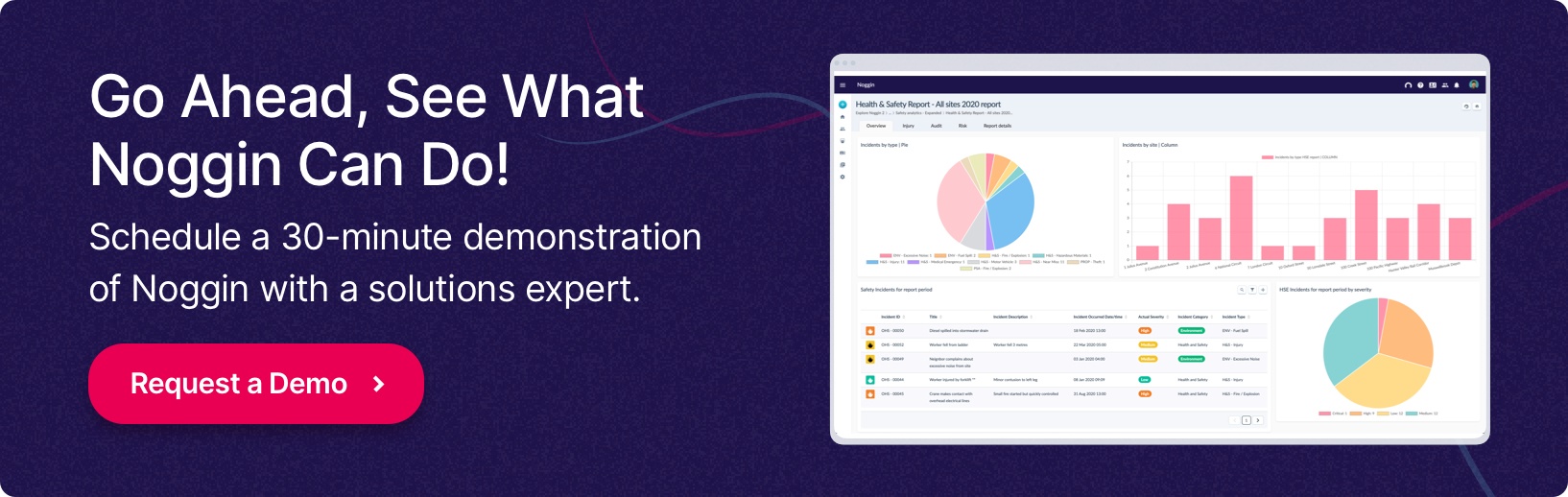
But don't just take our word for it. Request a demo to see Noggin in action.