




















.svg)
.svg)
.svg)
Long-term strategic planning is a continuous and essential process that enables every success-driven organization to build a clear path forward. It forces the organization’s leaders to evaluate how well it truly lives by its mission and values, identify the outcomes it seeks to achieve within the next three to five years, and establish a course to deliver those outcomes composed of viable actions and measurable benchmarks along the way.
When your organization develops and executes its long-term strategic plan, every successful operation, whether it’s a more common occurrence like a production cycle or a less common one like a procedural improvement initiative, brings your organization closer to achieving its strategic goals. The more successful operations you accomplish, the more progress you make, leading to higher team morale and satisfaction regarding the organization’s overall trajectory.
Conversely, when your organization experiences disruption or damage, it not only knocks your teams off course, but also creates new problems to solve before they can continue making progress toward long-term goals. Your teams must now resolve the disruption, and hopefully its underlying causes, identify and repair any damage it created, and perhaps most importantly, take whatever steps necessary to resume normal operations.
There’s no way to completely prevent adverse events from occurring. When they do happen, though, having a business continuity strategy in place helps your organization anticipate what’s required to efficiently solve problems like these and work to expediently get back on track.
To fully explore how business continuity planning is a critical element of your organization’s long-term strategic planning, we’ll cover what business continuity planning is, the basic steps to developing a sound business continuity strategy, and how emerging technology can help you deftly execute your business continuity management strategy when it matters most.
What is business continuity planning?
Business continuity planning is the process by which organizations assess their operational weaknesses and dependencies, establish clear action-plans for adverse event scenarios, and design strategies for resolving disruptions and resuming normal operations. Unexpected incidents are a guaranteed part of organizational operation, but the difference between organizations that rebound quickly and those that don’t comes down to proactive readiness.
Components of a business continuity plan
Your organization’s business continuity plan should consist of at least these two primary components:
1. Data backup
Structure a supplemental information and communication technology (ICT) strategy to protect the integrity of your primary ICT infrastructure and any data for which your organization has the responsibility of security.
2. Roles, responsibilities, and communication
Clearly designate roles for all involved members of your team so they understand their business continuity obligations and the chain of command. Provide clear channels of communication that can remain available should an outage shut down channels used in day-to-day operations.
Developing a business continuity strategy
To design a robust business continuity plan and ongoing business continuity management strategy, your team needs to know what your organization’s core operational processes are and how they may be at risk. This requires detailed analysis of day-to-day operations led by stakeholders with a thorough understanding of your production cycles and offering.
For your data storage and security infrastructure, your team must define your organization’s recovery point objective (RPO), which is the maximum acceptable amount of data loss you can withstand due to an adverse event, and its recovery time objective (RTO), which is the maximum acceptable amount of time to restore an outage and resume operations. These are thresholds against which your team can set clear recovery and resumption objectives.
More formally, your organization’s business continuity planning should include:
Business Impact Analysis (BIA)
Identify and evaluate how an adverse incident or incident type would affect the core processes of your organization’s operations. Map your dependencies, catalog available supplemental resources, and document what your organization would need to recover and resume normal operations.
Risk assessment
Identify and assess specific risks or areas of risk that your organization can proactively mitigate to limit the probability of a disruptive or damaging incident.
Testing and analysis
Run regular drills as training exercises to identify any weaknesses in your business continuity plan or response. Document findings to inform improvements, and perform regular maintenance to always keep your plan viable and ready.
How business continuity planning contributes to long-term strategic planning
Your organization’s business continuity posture informs and supports its long-term strategic plan in several ways, from assisting with development to bolstering your organization’s ability to achieve its long-term strategic goals.
Long-term strategic plan development
The work required to develop your organization’s business continuity plan and business continuity management strategy calls more attention to key elements of your organization’s core processes, infrastructure, risk landscape, and dependencies. These are some of the same critical attributes that inform the development of your long-term strategic plan, from setting objectives to determining which actions are viable and benchmarks are attributable.
Additionally, as both business continuity planning and long-term strategic planning is usually the responsibility of one or multiple members of organizational leadership, many of the same team members are involved in both development efforts. This fortuitous overlap prevents the need for duplicative exploratory efforts when performing vital tasks for plan development, such as performing a business impact analysis, assessing risks, and determining your RPO and RTO.
Long-term strategic plan execution
When adverse events happen, they present a multifaceted threat to your organization’s ability to perform day-to-day operations, which in turn threatens its potential to achieve its long-term strategic goals. Luckily, this is exactly why a thoughtful business continuity strategy anticipates what’s required to efficiently identify and repair damage, resolve disruption, and get back to the business of delivering value to your customer base.
The faster your business continuity plan enables your organization to solve problems like these, the more quickly your organization can resume normal operations. The strength of your resilience posture enables your organization to stay on course to complete actions-items within your long-term strategic plan and achieve more desired long-term outcomes in the process.
Long-term strategic plan analysis and improvement efforts
After your organization executes your business continuity plan in response to an adverse effect, your business continuity team should review and document its effectiveness at resolving disruption and restoring operations. This not only leads to key insights about how your business continuity plan can improve, but also about how your team views your organization’s ability to achieve the outcomes or pursue the course codified in its long-term strategic plan.
Your leadership team may determine that outcomes once thought to be impossible within a given timeframe suddenly seem feasible. On the other hand, they may assess that outcomes once seen as achievable through the current strategy now appear less so. It’s an opportunity to reevaluate the viability of your long-term strategic plan and make adjustments where they are needed to correct course, for better or worse.
Business continuity planning software capabilities that contribute to long-term strategic planning
As more of the everyday logistics of business continually shift from physical spaces to digital spaces, the logistics of resilience, including business continuity planning, must shift accordingly. Therefore, digital solutions like business continuity management software are the most intuitive and futureproofed ways to manage your business continuity planning, digitize the execution of your business continuity plan as needed, and track performance to drive improvements.
The best business continuity software available helps your organization develop, implement, and analyze the most effective business continuity strategy by enabling your team to:
- Simplify your BIA process and drive engagement with built-in, step-by-step guidance to ensure the capture of rich, insightful data that helps you truly understand your business
- Identify and map dependencies quickly, stay informed when one is at risk, and visualize and track them to make informed decisions and take effective risk mitigation actions
- Input a consistent recovery strategy across your organization including response plans, roles, responsibilities, and checklists, which can be deployed in seconds when needed
- Test event scenarios to ensure your teams are prepared to handle any situation
- Replace paper-based, static business continuity plans with dynamic, digitized plans that are easy to adjust, always up-to-date, and available on any device
- Gain greater visibility of your business continuity posture and offer more transparency to team members with flexible dashboards and analytics capabilities
- Manage business continuity processes proactively and uncover valuable insights with consolidated data and business intelligence visualization on interactive dashboards
- Inform decision-making with custom reports including historical data with charts, recommendations, and automated approvals, and publish them or share via email
With a streamlined user experience that makes your organization’s resilience posture easier to maintain, business continuity management software is a cornerstone of your organization’s long-term strategic planning. Newer business continuity tools like Noggin’s may deliver even more intelligence and control, but the central goal of business continuity planning will always remain the same — to keep your organization focused and working toward the future.
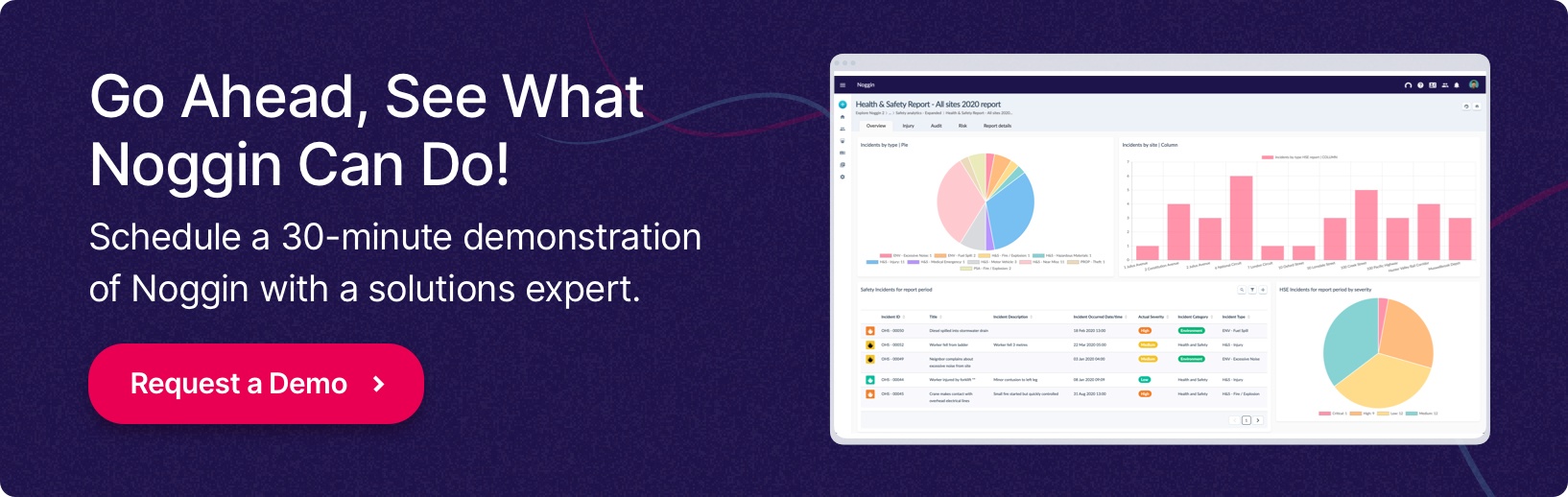
To stay ahead of the curve and prepare for your next unexpected operational challenge, request a demo of Noggin today and explore it for yourself.
.svg)