




















.svg)
.svg)
.svg)
As the world grows more interconnected and technologically driven, the risk landscape for organizations becomes more difficult to predict. Risk analysts must not only account for more factors that can impact the ability of an organization to perform its core functions or recover from a disruption, but every factor within this calculus, new or old, is likely to become increasingly complex over time.
The one thing that your organization can reasonably predict is that no matter how prepared you are for the future, disruptions will occur. This is why the organizations that rebound from disruptions quickly and comprehensively are those that instill proactive readiness into their overall resilience posture, particularly in the form of business continuity planning.
Business continuity planning is the process by which your organization assesses its operational weaknesses and dependencies, establishes clear action-plans for adverse event scenarios, and designs strategies for resolving disruptions and resuming normal operations. The more deeply your organization understands its core processes and the parameters of its potential risks, the more predictably effective your business continuity plan will be when executed.
Given this, it should be no surprise that data analytics has played an increasingly significant role in organizations’ business continuity planning efforts. As advanced data modelling and data analysis functions become more widely accessible, organizations have relied more heavily on them to catalog, assess, and interpret the ever-increasing volume of data associated with performing day-to-day operations, mitigating risk, and everything in between.
To understand how data analytics can enhance business continuity planning, we’ll look at the elements of business continuity that data analytics can help improve, some benefits of using data analytics as part of business continuity planning, and some of the emerging technologies that incorporate data analytics into a more robust overall business continuity solution.
The key components of business continuity planning that data analytics can improve
As many organizations’ operations have incorporated more sophisticated technologies, more of their core processes have become performed and managed digitally, and therefore, are more quantifiable in nature. This shift has enabled organizations to identify more accurate benchmarks for performance, calculate how much risk certain types of threats may pose, and evaluate how efficiently normal operations have resumed or a disruption has been resolved.
Some of the most critical components of business continuity with which data analytics can assist include:
Business Impact Analysis (BIA)
A business impact analysis helps your organization to identify and evaluate how an adverse incident or incident type would affect the core processes of your organization’s operations. This includes mapping your dependencies, cataloging available supplemental resources, and documenting what your organization would need to recover and resume normal operations.
Risk assessment
Risk assessment helps you to identify and evaluate specific risks or areas of risk that your organization can proactively mitigate to limit the probability of a disruptive or damaging incident. The more thoroughly your organization understands the history of its risk landscape, the more proactively you can allocate resources to either lessen the negative impact of a potential adverse event or, more preferably, prevent it altogether.
Testing and exercise
Another highly recommended element of business continuity planning is running regular drills as training exercises to identify weaknesses in your business continuity plan or response. After each series of exercises, look for ways to document your findings to inform improvements, and perform regular maintenance to always keep your plan viable, current, and ready.
The benefits of data analytics for business continuity planning
Data analytics can sort and analyze raw historical data to help you recognize trends or patterns, generate insights to inform decision-making, and build visualization models to more easily communicate findings with stakeholders. By channeling the processing power of data analytics in business continuity planning, you’ll be able to read more deeply into your past performance, enabling more data-driven decisions to improve future performance.
Some benefits of relying on data analytics for business continuity planning include:
Enhanced risk identification and assessment
For your BIA, data analytics can help you identify which core processes are the most strategically critical, so they can be prioritized accordingly during post-incident recovery. This way, your organization can restore the most essential areas of function first, limiting the magnitude of disruption to your core offering caused by an adverse event.
For risk assessment activities, data analytics can help quantify the impacts of and trends presented by prior disruptions, the efficacy of prior recovery efforts, and the efficiency of how recovery resources were deployed after prior incidents. The patterns that data analytics can reveal about prior incidents illuminate new opportunities to make different decisions and drive more favorable results in the future.
Improved risk mitigation scenarios
Scenario planning is a method of strategic risk analysis that models both the initial impacts and downstream effects of tactical decisions, allowing you to view a multitude of variations in performance and make the best-fit choice to drive the outcome you want. By incorporating data modelling into scenario planning, you can generate more accurate predictive analytics to assess potential risks and more deeply understand the likely effects of strategic decisions.
Data-driven decision making
Every point throughout your business continuity planning efforts, from risk assessment to recovery resource allocation, can be enhanced through data analytics to enable more data-driven decision making, leading your organization toward more predictably favorable results.
For example, after performing training exercises, data analytics can help your organization to assess their efficacy by reading trends from historical performance data and generating insights to identify areas of improvement and recommend improvement methods. The more regularly testing is performed, the more data can be fed into the model, and the more accurately its analysis can positively affect your level of preparedness.
Choosing business continuity management software with data analytics for business continuity planning
With all of these advantages, it’s clear that incorporating data analytics into business continuity planning can only improve your organization’s preparedness and overall resilience posture. Luckily, the latest generation of advanced technological tools for business continuity planning, such as business continuity planning software, already integrates data analytics into its larger business continuity offering, putting those benefits right at your fingertips.
For every part of business continuity planning, from BIAs to running drills, the best business continuity software should enable your team to:
- Simplify your BIA process and drive engagement with built-in, step-by-step guidance to ensure the capture of rich, insightful data that helps you truly understand your business
- Identify and map dependencies quickly, stay informed when one is at risk, and visualize and track them to make informed decisions and take effective risk-mitigation actions
- Input a consistent recovery strategy across your organization including response plans, roles, responsibilities, and checklists, which can be deployed in seconds when needed
- Test event scenarios to ensure your teams are prepared to handle any situation
- Replace paper-based, static business continuity plans with dynamic, digitized plans that are easy to adjust, always up-to-date, and available on any device
- Gain greater visibility of your business continuity posture and offer more transparency to team members with flexible dashboards and analytics capabilities
- Manage business continuity processes proactively and uncover valuable insights with consolidated data and business intelligence visualization on interactive dashboards
- Inform decision-making with custom reports including historical data with charts, recommendations, and automated approvals, and publish them or share via email
The nature of business continuity planning, risk assessment, and scenario planning will only grow more sprawling and multifactorial over time. And so, the organizations that will be best prepared to meet the challenges of an increasingly complex risk landscape are those that adapt sooner to the need for the advanced processing power of data analytics with business continuity solutions like Noggin as an essential element of their business continuity planning activities.
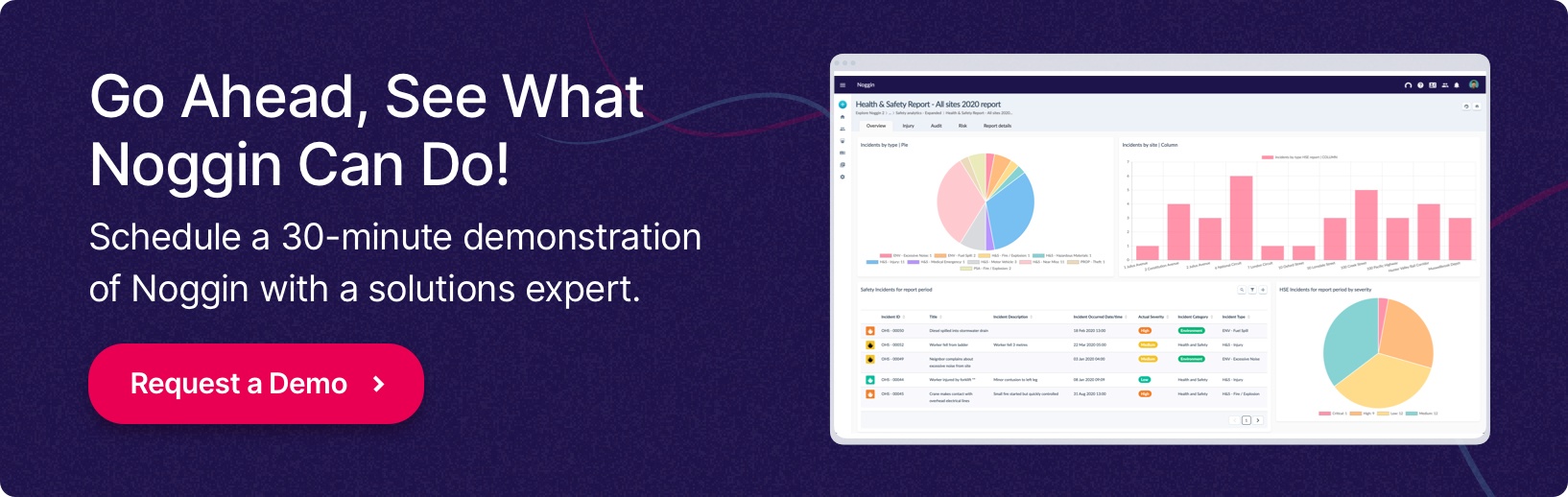
But don’t just take our word for it — request a demo of Noggin today and see for yourself.
.svg)