




















.svg)
.svg)
.svg)
Climate-driven crisis events are increasing in kind, cost, and intensity. The U.S. alone experienced 27-billion-dollar weather and climate disasters in 2024, on the heels of an historic season in 2023.
As a result, enterprises and agencies are clamoring to get more out of their emergency software. What should they be looking for?
Climate-driven crisis events are on the rise
Nor is the U.S. alone. In data taken from a Select Committee report into that nation’s disaster resilience, Australia’s National Emergency Management Agency (NEMA) calculates that more than 200 disaster events have taken place in the country since 2019. More than 1,600 disaster declarations have been issued across 434 local government areas (LGAs) in that same period.
In fact, half of Australia’s LGAs were subject to a disaster declaration in 2022. A staggering 70% of Australians, some 18 million people, lived in an LGA impacted by a disaster event.
Some LGAs were impacted by multiple events.
Meanwhile, the average number of people living in an impacted area doubled over the past decade, according to data from KPMG.
Globally, trendlines are dismal, as well.
According to the BCI’s Emergency & Crisis Communications Report 2025, adverse weather topped the list of triggers for emergency communications plans.
This isn’t the only indication that climate-driven crises are on the rise. Extreme weather events were the top driver of crisis activations in 2024, according to the BCI’s Crisis Management Report.
Meanwhile, natural catastrophes remained the third most important global business risk for 2025, according to the Allianz Risk Barometer.
Limitations of current emergency software
A common refrain emerges in post-incident reports. And that is poor coordination is impacting the efficacy of assistance.
In Australia’s Boots on the ground report, authors highlighted the need to better match up volunteers with the work that needs to be done:
“…there is no good, integrated data system in Australia where those jobs are fed into a single system and the volunteers are fed into another system and you can marry the two up. The data is just all over the place. And that can potentially keep the ADF in the field for longer than they necessarily need to be.”
Nor was that the only mention of emergency software. Report authors also played up the importance of emergency technology in enhancing disaster communication and response capabilities in disaster-prone areas.
How’s the software market faring, though?
Common frustrations with traditional emergency platforms include:
- Static data models and outdated algorithms
- Poor integration with real-time data sources
- Lack of alerting
- Failure to adapt to local contexts and evolving threats
How emergency software must evolve
The software market, as such, must evolve to meet the demands of customers dealing with increased climate threats.
Emergency software capabilities that can meet the moment include:
Built-in templates and workflow tools
In critical situations, fast and accurate communication is essential to protect employees, support customers, and maintain business continuity. Emergency management solutions should, therefore, come equipped with built-in templates and workflow tools to allow teams to prepare messages and tasks in advance.
Emergency platforms should automate key actions, as well, such as sending multilingual alerts.
Broad system integrations also help close communication gaps, ensuring timely alerts reach everyone.
To that end, emergency software should mirror desktop functions that let responders manage incidents on the go. Solutions should also help minimize human error, especially under pressure.
Integrated resilience
A full-featured emergency management platform should support broader safety and continuity efforts, with functionality that enables manual checklists to be converted into automated tasks with real-time tracking.
Whether dealing with a cyberattack or shifting data center operations, the same platform should be able to coordinate response activities across use cases.
Historical risk data and analytics
Emergency management systems should also help organizations build tailored response strategies based on their unique threats, operations, and regions.
Emergency management solutions should, therefore, offer historical risk data and analytics to enable teams to learn from past incidents, test response options, and make better decisions.
Platforms should also support previewing messages, identifying process delays, and running simulations.
Similarly, strong visual dashboards help responders quickly locate affected sites and reach employees in danger. Detailed reports should show, for example, who hasn't acknowledged alerts or which recovery actions are overdue.
Emergency software capabilities needed to combat climate risk
Fortunately, enterprises and agencies won’t have to wait for the emergency management software market to evolve to their needs. Certain advanced emergency platforms are already leading the pack with fit-for-purpose functionality.
The best emergency software for your needs already comes equipped with the following capabilities:
All hazards incident management
Streamlined incident response using best-practice, all-hazard incident management standards from around the world, including AIIMS, NIMS/ICS, and JESIP.
Situational awareness
Common operating picture created to maintain situational awareness via field personnel updates, GIS feeds, data import, email, and social media. Critical information displayed on comprehensive dashboards, incorporating external data feeds from across the web.
EOC Management
Emergency Operations Centers stood up at local, regional, state, and national levels. Multiple related local incidents wrapped up into a single regional view. Interfaces are fully tailored to the role and level of the user.
Team activation, roles, and collaboration
Emergency response efforts synchronized and aligned to team activation notifications, defined roles and responsibilities, and a centralized location to collaborate, share information, and record event critical information.
Mapping
Esri ArcGIS, WMS, KML, GeoJSON, or other sources incorporated, to view asset locations in the context of weather threats and critical infrastructure protection.
Emergency messaging
Crucial information communicated easily, whether via email, SMS, voice message, push notifications, or within the app itself.
Cloud-based notifications
Information can be sent via SMS text, voice calls, email, desktop pop-ups, mobile apps, social media, landline phones, IPAWS, RSS, CAP, digital signage and more. Target and follow up with subsets of your population based on location, lists, and responses.
A confirmation screen displays the quantity of people you’re about to alert before alerts are sent. Training mode to get real experience without fear of accidentally sending a message. Administrators can only see the options you want them to see.
Response plans and checklists
Response plans and checklists requested, activated, and automated to ensure response teams are following the same playbook. The best emergency software for your needs makes each step assignable and rolls up to easily view progress during an incident.
Geopolls
Geolocation, health updates, scheduling requests, and more can be solicited in real time with polls. Quickly view the locations and statuses of people in your community who need help. Follow up messages can be sent to respondents based on their answer.
Documentation and forms
Custom sitreps, briefings, objectives, and incident action plans are prepared, and Incident Command System forms are built. Automatic population of fields with default or calculated values to reduce error and save time
Conclusion
Finally, the data reveals that climate-related emergencies are on rise. But traditional emergency solutions haven’t kept up, leaving enterprises and agencies vulnerable to this grave resilience threat.
Where to turn to? As the climate continues to change, solutions like Noggin are meeting the moment, with emergency and incident management functionality that keeps your whole incident management team, from the emergency manager to untrained field staff, following the same plans, communicating on the same platform, and viewing the same operating picture.
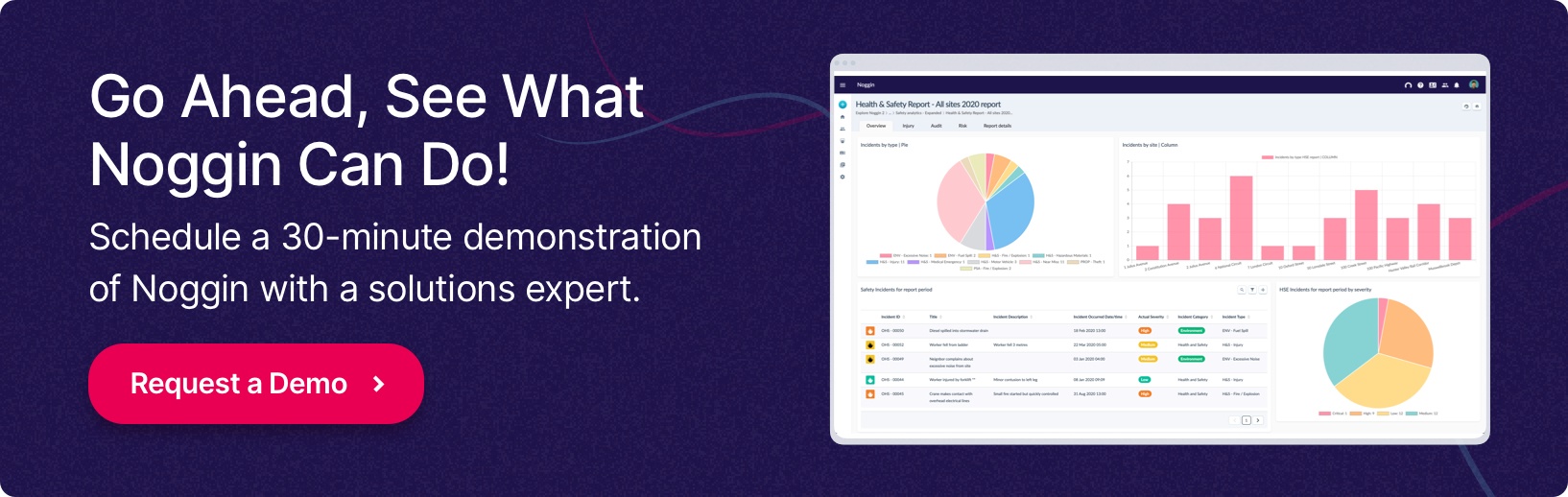
But don’t just take our word for it. See Noggin in action for yourself in a software demonstration.
.svg)