




















.svg)
.svg)
.svg)
When a crisis occurs at your organization, it’s really two things happening at once.
First, it’s a time-sensitive situation that can impinge on the health, safety, and security of your organization’s personnel, property, or other assets that must be addressed as quickly as possible to minimize damage and mitigate risk of further loss.Second, it’s a test of your organization’s resilience program for crisis management, including the crisis management tools, crisis management platforms, and other protocols that have been initialized, prepped, and tested for such an occurrence.
One of the most important elements of your organization’s crisis management program is its incident reporting and incident documentation protocol. Incident reporting — the gathering and recording of key incident details and evidence — enables your crisis management team to act with prudence during a crisis and derive insights for response plan improvements afterward.
Let’s look deeper at the importance of incident reporting and incident documentation in crisis management, how crisis management software can help you respond during a crisis and prevent future crises, and what distinguishes Noggin’s crisis and incident management software as the best crisis management software available today.
Incident reporting for effective crisis management
At a time of crisis, your organization’s resilience program should enable your team to gather accurate information in a centralized, accessible space so that prudent decisions can be made about how to carry out response efforts.
Your program should also enable your team to gather key details after an incident — about the incident itself and your organization’s response — to assess its full scope, why it occurred, how it could have been detected or prevented, and how effective the response was.
This is why it is important for your crisis management program to include a robust incident reporting and incident documentation tools and platforms in its crisis management protocol. These tools give your organization the ability to create and maintain a “single source of truth” that acts as a hub for qualitative and accurate information and enables clear communication, thorough assessments, and insights for future improvements.
Here's how incident reporting works during and after a crisis:
Incident reporting during a crisis
During an ongoing crisis, every second counts. The effectiveness of your organization’s crisis management program depends on your team’s ability to gain and maintain situational awareness, make informed decisions, and act with clarity and precision.
To facilitate these objectives, your organization’s incident reporting protocol should prompt team members to seek, collect, and input the types of data that best serves crisis management leads to assess status and determine next steps.
Critical information to be gathered for incident reporting during a crisis include:
- What happened, in as much detail as can be collected
- Who is involved, affected, or potentially affected should conditions worsen
- Where and when it happened
- Why it happened, as much as can be determined at that time
Thorough incident reporting should also include documentary and multimedia evidence as time and opportunity allows, including:
- Emails or other communications
- Event logs, reports, or other documents
- Photos
- Videos
It’s important to note that a crisis is often a constantly changing situation. Once a principal set of information has been gathered, your incident reporting protocol should consider directing some team members to continually monitor and update incident reporting tools with the latest information. This way, crisis management leads can stay up-to-date and capable of making best-fit decisions as the situation remains in flux.
Incident reporting after a crisis has occurred
Once a crisis is no longer ongoing, threats to health, safety, and security tend to downgrade, becoming less imminent over time until they are no longer active. This shift helps the situation to become less time-critical, which, in turn, helps it adjust to a kind of stasis, as elements that were once volatile and fluctuating start to settle and crystallize.
For incident reporting and incident documentation, this is a much easier situation to navigate. First, as the situation changes from dynamic to static, your personnel, property, and assets should, in all likelihood, become safer over time.
Second, without the hectic energy and time constraints of an active incident, data-collecting efforts can become more careful, nuanced, and qualitative. There likely wasn’t enough available person-hours to gather every relevant detail before, but after the worst is over, your incident reporting protocol should afford your team the room to put together more comprehensive documentation that builds on earlier work while filling in informational gaps.
The benefits of incident reporting
With the support of a robust incident reporting protocol, your organization will be better positioned to make continued resilience improvements. Beyond improved resilience, here are some other key benefits of incident reporting:
Risk assessment and recurrence prevention
Once your team has completed all info-gathering activities and compiled the data, the resulting report becomes an effective road map for risk assessment. Your team’s analysis of the findings makes it possible to identify one or several fact patterns that hopefully will reveal:
- Why the incident occurred, including which factor or confluence of factors were most responsible
- How, if possible, the incident could have been predicted
- Which leading indicators to look for when assessing future risk
- How, if possible, such an incident can be prevented
- Which operational procedures, standard operating practices, or other organizational protocols can be updated to prevent recurrence, and how they should be updated
Many times, an incident occurs when one or several unforeseen factors — whether environmental or procedural, internal or external — meets with an organizational weakness or lack of preparedness. By understanding what happened and why, your team will be able to determine if an incident was detectable, and therefore, if it was preventable.
Often, the detectability or predictability of an incident acts as a leading indicator of its preventability. The more insights that can be gleaned through incident reporting and incident documentation, the more that your organization can do to enhance preparedness activities, and hopefully, prevent another such incident from occurring.
However, just because an incident was proven through analysis to have been detectable or predictable does not necessarily mean it was preventable. For example, a seismograph can help us to predict earthquakes, but it cannot do anything to prevent them from occurring.
Accountability
Identifying the predictability and preventability of an incident also helps to encourage a culture of accountability. If attribution is possible, it’s important that team members be accountable for their contribution to an incident, whether through action or inaction, so that protocols can change, readiness can improve, and recurrence can be prevented.
That said, attribution isn’t always possible. Sometimes, in spite of strong, tested operational risk management and resilience programs, things happen that are beyond everyone’s control. And if incident reporting reveals this to be the case, it’s also an acceptable outcome.
Legal, regulatory, and insurance requirements
Once a complete data set is gathered and documented, your organization will be better positioned to fulfill any legal, regulatory, or insurance obligations. This may include the compilation and dispatch of reports, along with documentary or multimedia evidence as requested. Affiliated organizations, such as regulatory bodies or insurance claims personnel, likely have their own additional forms or other requirements to accompany such submissions.
The advantages of crisis management software for incident reporting
We’ve established what incident reporting and documentation is, and the purpose and value it brings to your organization. But an effective crisis management platform must not only account for what your team needs to do and why, but also deliver a process that makes carrying out your organization’s incident reporting protocol as intuitive and frictionless as possible.
Thankfully, there are powerful crisis management tools — most specifically, advanced crisis and incident management software — that let organizations empower their teams to more efficiently and effectively achieve its incident reporting and crisis management objectives.
Templates
While every incident is unique in a host of ways, enough incidents have been similar enough to enable crisis and incident management software to offer templates for different incident types. For example, equipment malfunctions have similar enough protocols for detectability, predictability, data-gathering, assessment, preventability, and reporting so as to have enabled the development of a standard baseline template for incident reporting and documentation.
Incident reporting templates like these prompt your team by guiding them to understand which key pieces of information to look for, how to find them, how to record them, how to analyze a completed incident report, and how to apply insights to improve resilience. This prevents teams from having to develop protocols manually or start from scratch for each incident, making the process faster and more qualitative for each incident.
Communication, escalation, and notification
The most intuitively designed crisis management system software creates adequate and appropriate space to build a “single source of truth” for incident reporting and incident documentation. But to effectively follow a crisis management protocol, that same space must include crisis management communication tools that keep roles and responsibilities clear and drive procedural alignment between crisis management team members.
Ideally, your crisis management platform should give team members clear communication channels to help them maintain unified situational awareness, escalate vital messages like briefings or debriefings to key stakeholders, or notify the larger organization to amplify situational awareness when it is appropriate to do so. This way, overall organizational alignment is preserved, and the organization can return to business as usual more quickly.
Compliance
When an incident occurs, questions about incident preparedness, organizational resilience, and business continuity are often soon to follow. Some of these questions may originate from within the organization, but it’s just as likely that some questions will come from a regulatory body whose purpose is to preserve the integrity of the government, industry, or system it serves.
Your crisis management platform should account for mandatory reporting requirements, both during and after an incident occurs, and offer your crisis management team adequate guidance to ensure such requirements are fulfilled accurately, completely, and on time. This way, team members aren’t responsible for identifying requirements or how to fulfill them on their own, which could easily jeopardize your organization’s ability to maintain consistent compliance throughout and beyond incident reporting and response.
Analytics
Just as there is enough consistency among types of incidents to generate crisis management response and incident reporting templates, that same procedural consistency yields templates for incident documentation analytics, reporting, and intelligence visualization. This enables your crisis management team to make an apples-to-apples comparison between incidents and the respective responses to each, helping them track your organization’s progress for resilience over time as it manages each successive similar event — or hopefully, fewer of them.
Automation
Every one of the previous areas is enhanced one way or another by the ease and utility of crisis information management software. Throughout the incident reporting process, it’s critical that each step be observed by teams to fully engage your organization’s crisis management protocol and achieve its intended objectives.
But considering how well defined the process is, a number of these steps can be automated. Automating key measures not only relieves team members of some guesswork, especially as some of them may not be as familiar with the process, but it further ensures that every step is addressed at the appropriate time, the right parties are contacted, and all obligations are met.
How Noggin’s crisis management software best supports incident reporting and documentation
Once your organization is ready to integrate crisis and incident management software into your crisis management, incident reporting, and incident documentation response plans, the software you choose should deliver all the advantages described above — but the best crisis management software should even go above and beyond.
Namely, your crisis management platform should help you:
- Manage all types of incidents and crises, from small spills to the most severe events
- Plan, coordinate, and streamline response efforts to minimize loss and mitigate risk
- Activate teams, assign response tasks, and keep stakeholders informed
- Consolidate info across multiple sources using customizable dashboards with elements like scrolling banners, live maps, and news feeds, and streams with up-to-the-minute weather, social media, traffic, and natural disaster data
- Drive team collaboration with dedicated chat groups for discussion, impact assessment, and response strategy development
- Keep information flowing and coordinate incident responses in real-time with email, SMS, voice, and app messages and push notifications
- Boost the value of post-incident reviews with valuable post-response assessments and resilience improvement activities
- Improve trend reporting, accountability, and insights with custom analytics dashboards built with high-performing metrics and data visualization
And Noggin is the only crisis management platform that does it all as part of our integrated resilience platform, including solutions for any other areas of operational readiness that your organization needs to improve.
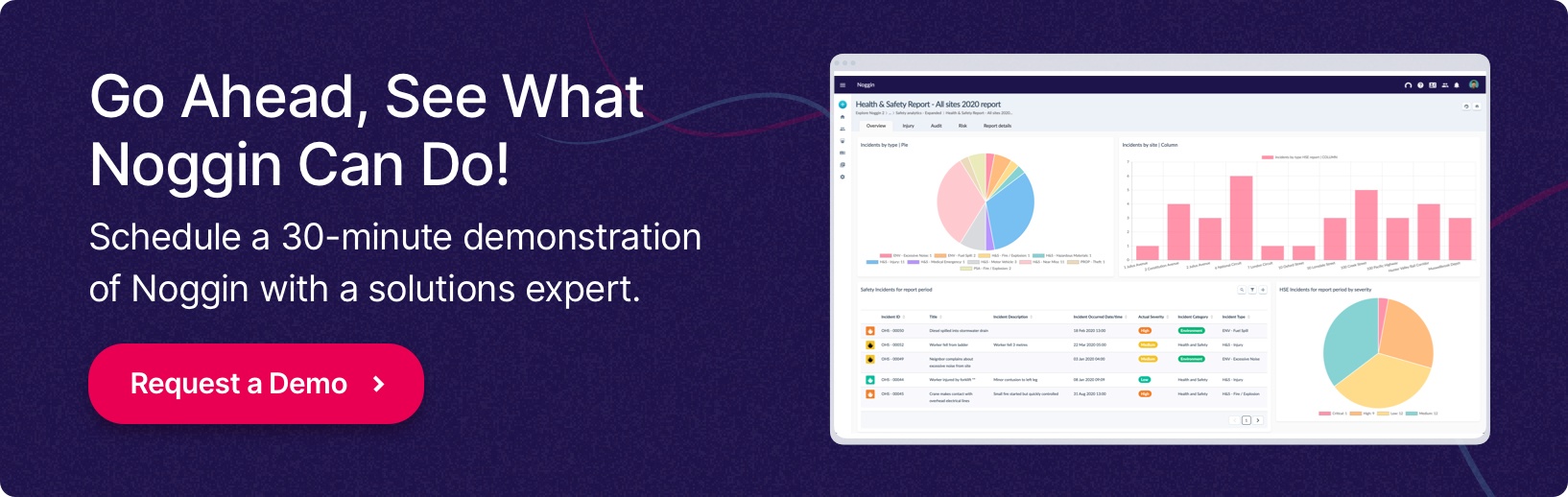
Request a demo of Noggin today, and see how much more effective your incident reporting and documentation program can be.
Well said.
.svg)